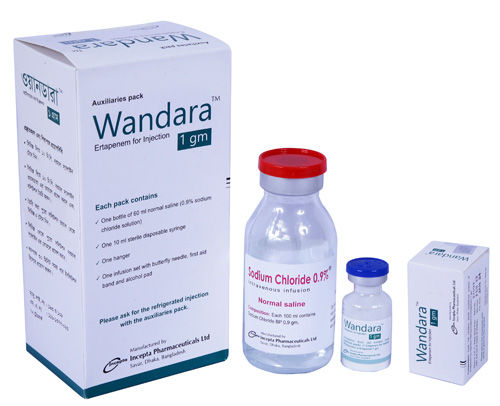
Wandara
Cheaper & Alternative Brands
Same generic (Ertapenem), same form (IM/IV Injection)
Clinical Prescribing Information
Medical monograph and safety information for healthcare professionals & patients.Indications & Clinical Uses
Treatment
: Erpen is indicated for the treatment of patients with moderate to severe infections caused by susceptible strains of microorganisms, as well as initial empiric therapy prior to the identification of causative organisms in the infections listed below:
Complicated Intra-Abdominal Infections
... Read more
Treatment
: Erpen is indicated for the treatment of patients with moderate to severe infections caused by susceptible strains of microorganisms, as well as initial empiric therapy prior to the identification of causative organisms in the infections listed below:
Complicated Intra-Abdominal Infections
Complicated Skin and Skin Structure Infections including diabetic lower extremity and diabetic foot infections
Community Acquired Pneumonia
Complicated Urinary Tract Infections including pyelonephritis
Acute Pelvic Infections including postpartum endomyometritis, septic abortion and post surgical gynecologic infections
Bacterial Septicaemia
Prevention
: Erpen is indicated in adults for the prophylaxis of surgical site infection following
elective colorectal surgery.
Contraindications
Ertapenem is contraindicated in patients with known hypersensitivity to any component of this product or to other drugs in the same class or in patients who have demonstrated anaphylactic reactions to beta-lactams. Due to the use of lidocaine HCl as a diluent, intramuscular administration of Ertapenem is contraindicated in patients with a known hypersensitivity to local anaesthetics of the amide type and in patients with severe shock or heart block.
Side Effects & Adverse Reactions
Most adverse experiences reported in these clinical studies were described as mild to moderate in severity. The most common drug-related adverse experiences reported during parenteral therapy with Erpen include Headache, Infused vein complication, phlebitis/ thrombophlebitis, Diarrhoea, nausea and vomiting.
Other uncommon side effects include- Dizziness, somnolence, insomnia, seizure, confusion, Extravasation, hypotension, Dyspnoea, Oral candidiasis, constipation, acid regurgitation, C. difficile-associated diarrhoea, dry mouth, dyspepsia, anorexia, Erythema, pruritus, Abdominal pain, taste perversion, asthenia/fatigue, candidiasis, oedema/swelling, fever, pain, chest pain, Vaginal pruritus.
Warnings & Precautions
Before initiating therapy with Erpen, careful inquiry should be made concerning previous hypersensitivity reactions to penicillins, cephalosporins, other beta-lactams and other allergens. If an allergic reaction to Erpen occurs, discontinue the drug immediately. Serious anaphylactic reactions require immediate emergency treatment.
As with other antibiotics, prolonged use of Erpen may result in overgrowth of non-susceptible organisms. Repeated evaluation of the patient's condition is essential. If superinfection occurs during therapy, appropriate measures should be taken.
Pseudomembranous colitis has been reported with nearly all antibacterial agents, including Erpen, and may range in severity from mild to life-threatening. Therefore, it is important to consider this diagnosis in patients who present with diarrhoea subsequent to the administration of antibacterial agents. Studies indicate that a toxin produced by Clostridium difficile is a primary cause of "antibiotic-associated colitis".
Pharmacology & Mechanism of Action
Ertapenem for Injection is a sterile, synthetic, long-acting, parenteral, 1-β methyl-carbapenem that is structurally related to beta-lactam antibiotics, such as penicillins and cephalosporins, with activity against a wide range of Gram-positive and Gram-negative aerobic and anaerobic bacteria.
Ertapenem exhibits a bactericidal mode of action. It works by binding to and inhibiting bacterial penicillin-binding proteins (PBPs). In Escherichia coli, it has a strong affinity toward PBPs 1a, 1b, 2, 3, 4 and 5 with preferential binding to PBPs 2 and 3. Upon binding to PBPs, ertapenem inhibits bacterial cell wall synthesis by interfering with the lengthening and strengthening of the peptidoglycan portion of the cell wall, thereby inhibiting cell wall synthesis.