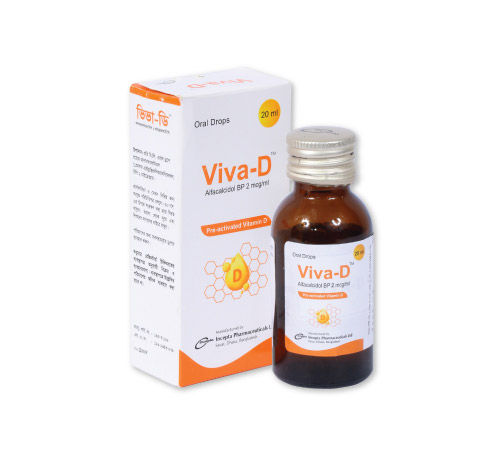
Viva-D
Cheaper & Alternative Brands
Same generic (Alfacalcidol), same form (Pediatric Drops)No other brands currently registered with this exact active generic and dosage form.
Clinical Prescribing Information
Medical monograph and safety information for healthcare professionals & patients.Indications & Clinical Uses
Viva-D is indicated in adult patients with chronic renal failure for:
management of hypocalcemia
secondary hyperparathyroidism
osteodystrophy
Dosage & Administration
An initial dose of 0.25 mcg/day is recommended for the first 2 months, unless hypercalcemia develops. If hypercalcemia occurs then the dose should be reduced to 0.25 mcg on alternate days. If serum calcium is below the desired range, the dose may be adjusted in increments of 0.25 mcg/day every 2 months.
Maintenance Doses
: Most patients will be maintained on a dose of 0.5 mcg/day. However, doses up to 1 mcg/day may be necessary to maintain serum calcium within the desired range. Serum calcium and phosphate levels should be monitored at monthly intervals or as is considered necessary if hypercalcemia develops. If hypercalcemia develops at any time during treatment then the dose of alfacalcidol should be reduced by 50% and all calcium supplements stopped until calcium levels return to normal.
Pediatrics
: The safety and efficacy of Alfacalcidol in children has not been established.
Contraindications
Alfacalcidol is contraindicated:
in patients who are hypersensitive to this drug or to any ingredient in the formulation, including any non-medicinal ingredient, or component of the container. For a complete listing, see Dosage Forms, Strengths, Composition and Packaging.
when there is biochemical evidence of hypercalcemia, hyperphosphatemia, or evidence of vitamin D overdose.
Side Effects & Adverse Reactions
Elevated blood urea nitrogen (BUN), albuminuria, hypercholesterolemia, elevated aspartate aminotransferase (AST or SGOT) and alanine aminotransferase (ALT or SGPT), anorexia, weight loss, polydipsia, hyperthermia, dry mouth, metallic taste
Cardiac arrhythmia, hypertension
Conjunctivitis, corneal calcification, photophobia
Rhinorrhea
Overt psychosis
Headache, somnolence, vertigo
Diarrhoea, vomiting, constipation, nausea, pancreatitis
Pruritus
Muscle pain, bone pain, ectopic calcification
Polyuria, nocturia
Decreased libido
Fatigue, weakness
Warnings & Precautions
Pregnancy, lactation, renal impairment, infants, elderly. Monitor serum levels of calcium in patients with renal failure. Caution in hypercalciuria in those with history of renal calculi. Avoid in patients with hypersensitivity to inj. containing propylene glycol.
Pharmacology & Mechanism of Action
Alfacalcidol stimulates intestinal calcium and phosphorus absorption, the reabsorption of calcium from bone and possibly the renal reabsorption of calcium. In the majority of patients treated with Alfacalcidol, clinical symptoms of bone pain and muscle weakness begin to remit within 2 weeks to 3 months of the start of therapy. Malabsorption of calcium is rapidly corrected. In patients on daily oral therapy, plasma alkaline phosphatase and PTH levels generally begin to fall within 3 months, but plasma calcium levels may not normalize for several months. This delay should not necessarily be construed as a poor response but may indicate that calcium is being utilized for bone mineralization. The decrease in PTH levels may be more rapid in patients on intermittent intravenous therapy, with significant reductions being achieved within 3 months of therapy.