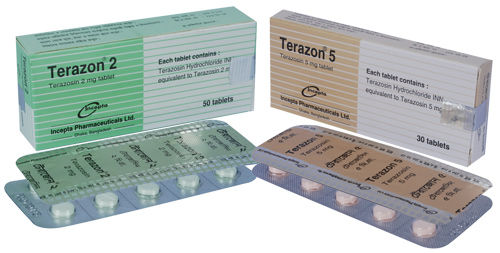
Terazon
Cheaper & Alternative Brands
Same generic (Terazosin Hydrochloride), same form (Tablet)Clinical Prescribing Information
Medical monograph and safety information for healthcare professionals & patients.Indications & Clinical Uses
Prostol is indicated in-
Single therapy is used to relieve from signs and symptoms of benign prostatic hyperplasia (BPH).
For the treatment of hypertension.
Dosage & Administration
Benign Prostatic Hyperplasia-
Initial dose
: 1 mg at bedtime is starting dose of all patients and this dose should not be exceeded.
Subsequent dose
: The dose slowly increases to achieve the desired response. The usual recommended dose range is 5-10 mg administered once a day.
Hypertension-
Initial dose
: 1 mg at bedtime is starting dose of all patients and this dose should not be exceeded.
Subsequent dose
: The dose slowly increases to achieve the desired response. The usual recommended dose range is 2-10 mg administered once a day.
Contraindications
Terazosin is contraindicated in patients known to be hypersensitive to Terazosin or its analogues.
Side Effects & Adverse Reactions
Postural hypotension is more commonly reported side effect. Dizziness, lack of energy, peripheral oedema; urinary frequency and priapism reported.
Warnings & Precautions
First dose may cause hypotension (within 30-90 minutes). Therefore should be taken on retiring to bed.
Caution should be observed when Prostol is administered with other antihypertensive agents, avoid the possibility of significant hypotension. When adding Prostol to a diuretic or other antihypertensive agent, dosage reduction and retitration may be necessary.
The patients should be cautioned to avoid situation such as driving and hazardous tasks where injury could result due to syncope after initiation of Prostol therapy.
Pharmacology & Mechanism of Action
Terazosin is selective for alpha-1-adrenoceptors but not their individual subtypes. Inhibition of these alpha-1-adrenoceptors results in relaxation of smooth muscle in blood vessels and the prostate, lowering blood pressure and improving urinary flow. Smooth muscle cells accounts for roughly 40% of the volume of the prostate and so their relaxation reduces pressure on the urethra.
It has also been shown that catecholamines induce factors responsible for mitogenesis and alpha-1-adrenergic receptor blockers inhibit this effect. A final long term mechanism of terazosin and other alpha-1-adrenergic receptor blockers is the induction of apoptosis of prostate cells. Treatment with terazosin enhances the expression of transforming growth factor beta-1 (TGF-beta1), which upregulates p27kip1, and the caspase cascade