
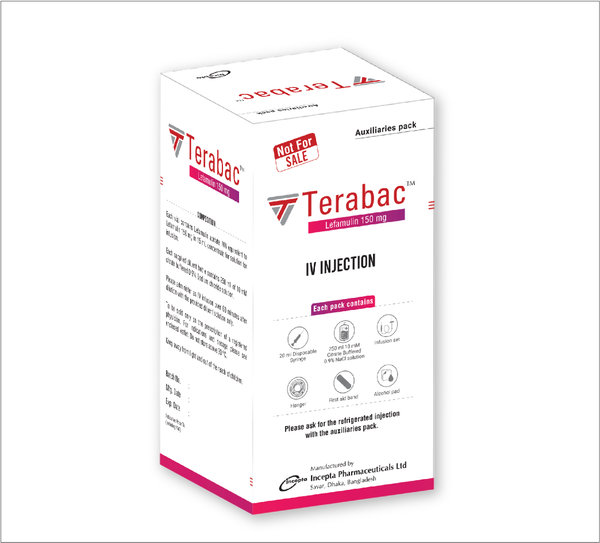
Terabac
 Generic: Lefamulin Acetate
 Daily Dose:
 Course Duration:
 Alternatives (3)
Cheaper & Alternative Brands
Same generic (Lefamulin Acetate), same form (IV Infusion)

Clinical Prescribing Information
Medical monograph and safety information for healthcare professionals & patients.Indications & Clinical Uses
Lefabac is indicated for the treatment of adults with community-acquired bacterial pneumonia (CABP) caused by the following susceptible microorganisms: Streptococcus pneumoniae, Staphylococcus aureus (methicillin susceptible isolates), Haemophilus influenzae, Legionella pneumophila, Mycoplasma pneumoniae, and Chlamydophila pneumoniae.
Dosage & Administration
Dosage of Lefamulin in Adult CABP Patients
: Lefamulin 150 mg injection every 12 hours by intravenous infusion over 60 minutes for 5 to 7 days (With the option to switch to Lefamulin Tablets 600 mg every 12 hours to complete the treatment course). Lefamulin tablet 600 mg orally every 12 hours for 5 days. For patients with severe hepatic impairment, dosage adjustment is required.
Dosage Adjustment for Patients with Hepatic Impairment-
Lefamulin Injection
: Reduce the dosage of Lefamulin Injection to 150 mg infused intravenously over 60 minutes every 24 hours for patients with severe hepatic impairment. No dosage adjustment of Lefamulin Injection is needed for patients with mild or moderate hepatic impairment.
Lefamulin Tablets
: Lefamulin Tablets have not been studied in and are not recommended for patients with moderate or severe hepatic impairment. No dosage adjustment of Lefamulin Tablets is needed for patients with mild hepatic impairment.
Important Administration instruction-
Lefamulin Injection
: Administer Lefamulin Injection by intravenous infusion over 60 minutes. Must dilute in a 250 ml solution of citrate buffered 0.9% sodium chloride for injection supplied with Lefamulin Injection before use.
Lefamulin Tablets
: Take Lefamulin Tablets at least 1 hour before a meal or 2 hours after a meal. Do not crush or divide Lefamulin Tablet.
Missed Dose
: If a dose is missed, the patient should take the dose as soon as possible and anytime up to 8 hours prior to the next scheduled dose. If less than 8 hours remain before the next scheduled dose, do not take the missed dose, and resume dosing at the next scheduled dose.
Preparation of Lefamulin Injection for Intravenous Infusion-
Dilute the entire 15 ml vial of Lefamulin Injection into the diluent bottle supplied with Lefamulin injection that contains 250 ml citrate buffered 0.9% sodium chloride solution.
Use aseptic technique when adding Lefamulin Injection into the diluent bottle. Mix thoroughly.
Use the diluent bottle only if the solution is clear and the container is undamaged.
Do not use the diluent bottle in series connections.
Do not add other additives to the diluent bottle because their compatibilities with Lefamulin Injection have not been established.
Contraindications
Lefamulin Acetate is contraindicated in patients with known hypersensitivity to Lefamulin, pleuromutilin class drugs, or any of the components of Lefamulin and also contraindicated for use with CYP3A4 substrates that prolong the QT interval. Lefamulin is not recommended for pregnant women and pediatric patients age below 18 years old.
Side Effects & Adverse Reactions
Lefabac has the potential to prolong the QT interval. Avoid Lefabac in patients with known QT prolongation, ventricular arrhythmias, and patients receiving drugs that may prolong the QT interval. Clostridioides difficile-associated diarrhea (CDAD) has been reported with nearly all systemic antibacterial agents, including Lefabac, with severity ranging from mild diarrhea to fatal colitis.
Warnings & Precautions
Clostridium Difficile-Associated Disease (CDAD) has been reported with the use of many antibacterial agents, including Lefabac IV CDAD may range in severity from mild diarrhea to fatal colts. It is important to consider this diagnosis in patients who present with diarrhea or symptoms of colitis, pseudomembranous colitis, toxic megacolon or perforation of the colon subsequent to the administration of any antibacterial agent. Lefabac IV has the potential to prolong the QT interval of the electrocardiogram (ECG) in some patients. Avoid Lefabac IV use in the following patients
Patients with known prolongation of the QT interval
Patients with ventricular arrhythmias including torsades de pointes
Patients receiving Class IA (for example, quinidine, procainamide) or Class IIIA (for example, amiodarone, sotalol) antiarrhythmic agents
Patients receiving other drugs that prolong the QT interval, such as antipsychotics, erythromycin, pimozide, moxifloxacin, and tricyclic anti-depressants
Pharmacology & Mechanism of Action
Lefamulin Acetate is a semi-synthetic antibacterial agent for oral and intravenous administration. Lefamulin features a novel mechanism of action that shows benefits against resistant bacteria that cause pneumonia. Lefamulin is a systemic pleuromutilin antibacterial. It inhibits bacterial protein synthesis through interactions (hydrogen bonds, hydrophobic interactions, and Van der Waals forces) with the A-and P-sites of the peptidyl transferase center (PTC) in domain V of the 23s rRNA of the 50S subunit.