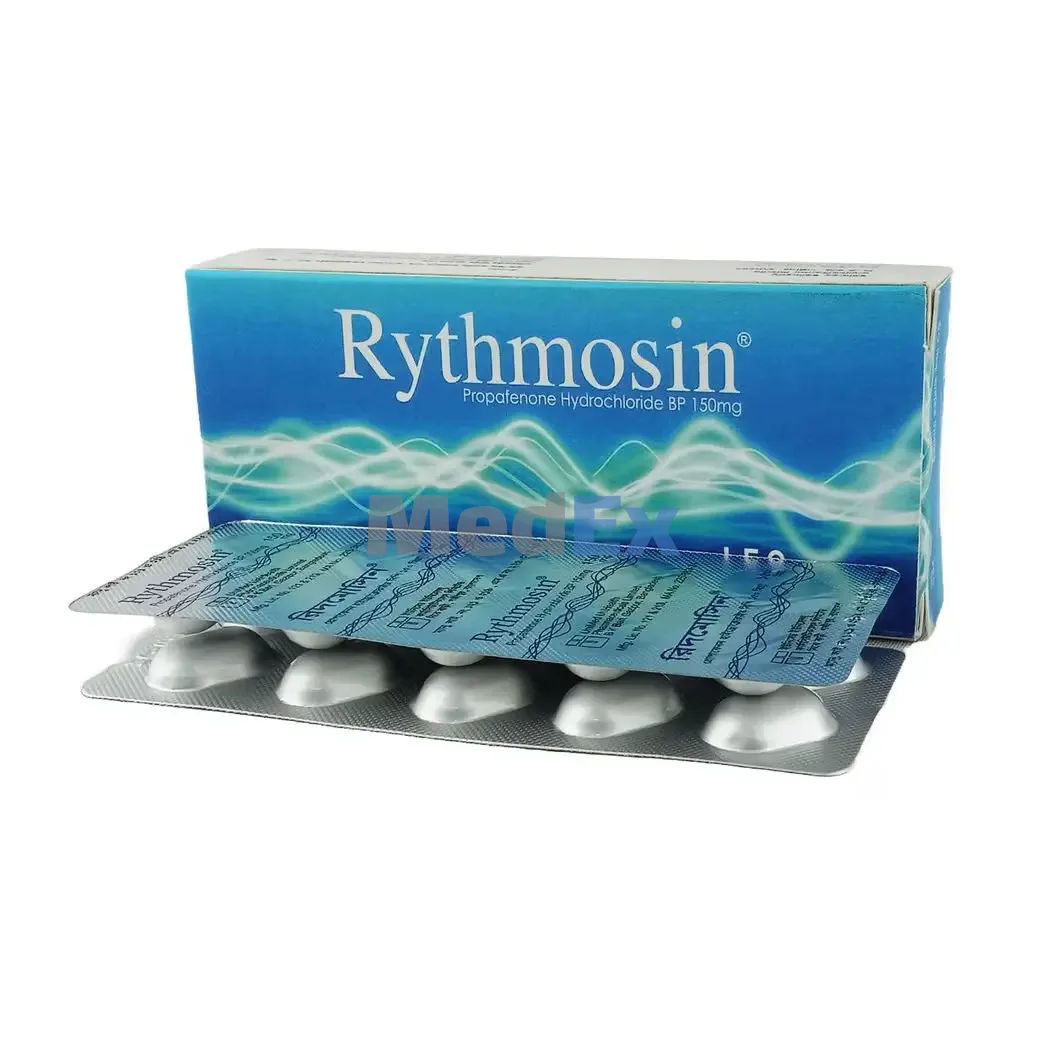
Rythmosin
Cheaper & Alternative Brands
Same generic (Propafenone Hydrochloride), same form (Tablet)No other brands currently registered with this exact active generic and dosage form.
Clinical Prescribing Information
Medical monograph and safety information for healthcare professionals & patients.Indications & Clinical Uses
Rythmosin is indicated for the treatment of paroxysmal atrial fibrillation/flutter (PAF), paroxysmal supraventricular tachycardia (PSVT). Rythmosin is also indicated for the treatment of documented ventricular arrhythmias.
Dosage & Administration
The dose of Propafenone must be individually titrated on the basis of response and tolerance. It is recommended that therapy be initiated with Propafenone 150 mg given every eight hours (450 mg/day). Dosage may be increased at a minimum of 3 to 4 day intervals to 225 mg every 8 hours (675 mg/day) and if necessary, to 300 mg every 8 hours (900 mg/day). The usefulness and safety of dosages exceeding 900 mg per day have not been established.
Contraindications
Propafenone is contraindicated in the presence of uncontrolled congestive heart failure, cardiogenic shock, sinoatrial, atrioventricular and intraventricular disorders of impulse generation and/or conduction (e.g. sick sinus node syndrome, atrioventricular block) in the absence of an artificial pacemaker, bradycardia, marked hypotension, bronchospastic disorders, manifest electrolyte imbalance and known hypersensitivity to the drug.
Side Effects & Adverse Reactions
Adverse reactions associated with propafenone occur most frequently in the gastrointestinal, cardiovascular and central nervous systems. Change in taste, constipation, diarrhea, dizziness, drowsiness, dry mouth, gas, headache, light-headedness, nausea, tiredness etc. may happen. Severe allergic reactions also reported with propafenone.
Warnings & Precautions
Hepatic Dysfunction:
Rythmosin is highly metabolized by the liver and should therefore, be administered cautiously to patients with impaired hepatic function. As a result, the dose of propafenone given to patients with impaired hepatic function should be approximately 20 to 30% of the dose given to patients with normal hepatic function.
Renal Dysfunction:
A considerable percentage of propafenone metabolites (18.5% to 38% of the dose/48 hours) are excreted in the urine. Until further data are available, propafenone should be administered cautiously to patients with impaired renal function.
Neuromuscular Dysfunction:
Exacerbation of myasthenia gravis has been reported during propafenone therapy.
Pharmacology & Mechanism of Action
Propafenone works by slowing the influx of sodium ions into the cardiac muscle cells, causing a decrease in excitability of the cells. Propafenone is more selective for cells with a high rate, but also blocks normal cells more than class Ia or Ib. Propafenone differs from the prototypical class Ic antiarrhythmic in that it has additional activity as a beta-adrenergic blocker which can cause bradycardia and bronchospasm.