
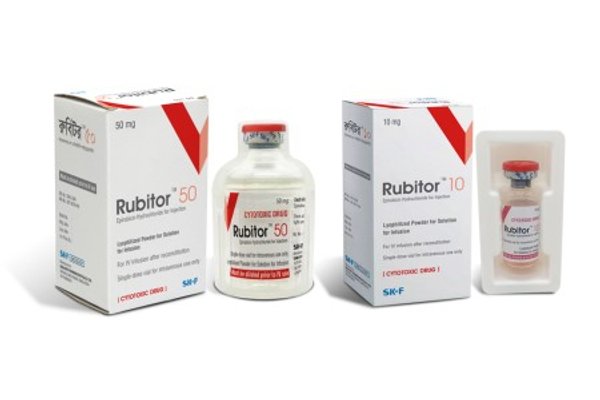
Rubitor
 Generic: Epirubicin Hydrochloride
 Daily Dose:
 Course Duration:
 Alternatives (10)
Cheaper & Alternative Brands
Same generic (Epirubicin Hydrochloride), same form (IV Infusion)

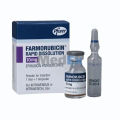
Clinical Prescribing Information
Medical monograph and safety information for healthcare professionals & patients.Indications & Clinical Uses
Epicin Injection is indicated as a component of adjuvant therapy in patients with evidence of axillary node tumor involvement following resection of primary breast cancer.
Dosage & Administration
When possible, to reduce the risk of developing cardiotoxicity in patients receiving Epirubicin after stopping treatment with other cardiotoxic agents, especially those with long half-lives such as Trastuzumab, Epirubicin-based therapy should be delayed until the other agents have cleared from the circulation. Epirubicin Injection should be administered by intravenous infusion. Epirubicin is given in repeated 3-to 4-week cycles. The total dose of Epirubicin may be given on day 1 of each cycle or divided equally and given on days 1 and 8 of each cycle.
The recommended dose of Epirubicin is 100 to 120 mg/m². The following regimens are recommended:
CEF-120:
Cyclophosphamide: 75 mg/m² PO D 1-14
Epirubicin: 60 mg/m² IV D 1, 8
5-Fluorouracil: 500 mg/m² IV D 1, 8
Repeated every 28 days for 6 cycles
FEC-100:
5-Fluorouracil: 500 mg/m²
Epirubicin: 100 mg/m²
Cyclophosphamide: 500 mg/m²
All drugs were administered intravenously on day 1 and repeated every 21 days for 6 cycles. Patients administered the 120-mg/m² regimen of Epirubicin should receive prophylactic antibiotic therapy. Or, as directed by the registered physician.
Contraindications
It is contraindicated in patients with known hypersensitivity to Epirubicin or other anthracyclines or anthracenediones or any other components of this product.
Side Effects & Adverse Reactions
Most commonly reported adverse effects are- Myelosuppression, cardiotoxicity, alopecia, hyperpyrexia, lethargy, amenorrhoea, nausea, vomiting, diarrhea, fever, rash, anorexia, harmless reddish appearance of urine for 1-2days.
Warnings & Precautions
Storage of the solution for injection at refrigerated conditions can result in the formation of a gelled product. This gelled product will return to a slightly viscous to mobile solution after 2 to a maximum of 4 hours of equilibration at controlled room temperature (15°-25°C). Inspect parenteral drug products visually for particulate matter and discoloration prior to administration, whenever solution and container permit. Procedures for proper handling and disposal of anticancer drugs should be used when handling and preparing Epicin.
Epicin Injection should be administered only under the supervision of qualified physicians experienced in the use of cytotoxic therapy. Before beginning treatment with Epicin, patients should be recovered from acute toxicities (such as stomatitis, neutropenia, thrombocytopenia, and generalized infections) of prior cytotoxic treatment. Also, initial treatment with Epicin should be preceded by a careful baseline assessment of blood counts; serum levels of total bilirubin, AST, and creatinine; and cardiac function as measured by left ventricular ejection function (LVEF). Patients should be monitored carefully during treatment for possible clinical complications due to myelosuppression. Supportive care may be necessary for the treatment of severe neutropenia and severe infectious complications. Monitoring for potential cardiotoxicity is also important, especially with greater cumulative exposure to Epicin.
Pharmacology & Mechanism of Action
Epirubicin Hydrochloride, an anthracycline with cytotoxic properties. It inhibits DNA and RNA synthesis by steric obstruction after intercalating between DNA base pairs that triggers DNA cleavage by topoisomerase II. It also inhibits DNA helicase and generates cytotoxic free radicals.
Distribution
: Following IV administration, Epirubicin is rapidly and widely distributed into the tissues. Binding of Epirubicin to plasma proteins, predominantly albumin, is about 77% and is not affected by drug concentration.
Metabolism
: Epirubicin is extensively and rapidly metabolized by the liver and is also metabolized by other organs and cells, including red blood cells.
Excretion
: Epirubicin and its major metabolites are eliminated through biliary excretion and, to a lesser extent, by urinary excretion. Terminal elimination half-life is 30-40 hrs.