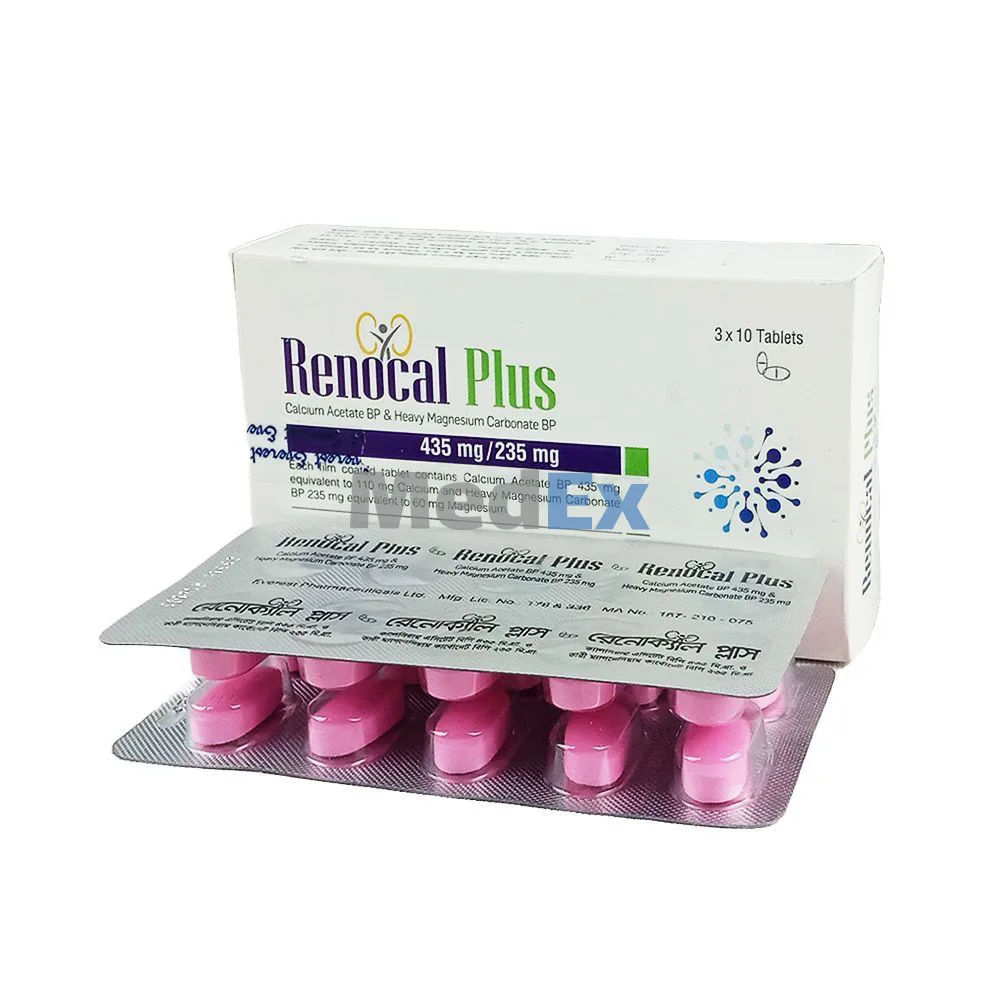
Renocal Plus
Cheaper & Alternative Brands
Same generic (Calcium acetate + Magnesium carbonate), same form (Tablet)No other brands currently registered with this exact active generic and dosage form.
Clinical Prescribing Information
Medical monograph and safety information for healthcare professionals & patients.Indications & Clinical Uses
Renocal Plus tablet is indicated in the treatment of hyperphosphatemia associated with chronic renal insufficiency in patients undergoing dialysis (haemodialysis, peritoneal dialysis). Renocal Plus tablet is indicated in adults.
Dosage & Administration
Adults
: 3 to 10 film-coated tablets per day, depending on the serum phosphate level. The daily dose should be subdivided according to the number of meals per the day (usually 3 a day). The recommended starting dose is 3 tablets daily. If necessary, the dosage may be raised to maximally 12 film-coated tablets per day.
Pediatric population
: The safety and efficacy of this tablet in children and adolescence have not been established. Therefore, the administration of this tablet is not recommended in children and adolescents below 18 years of age.
Method of administration
: To achieve the maximum phosphate binding effect, this tablet must be taken together with the meal and should not be crushed or chewed. For easy swallowing, the tablets should be taken together with some liquid. In case the tablets are too large to be swallowed by the patient, the tablets should be broken along the score line immediately before swallowing in order to avoid the development of taste of acetic acid. Because the rate and/or extent of absorption of other defined medicinal products may vary when used concomitantly with this tablet, none of the oral medicinal products should be taken within the period 2 hours before and 3 hours after administration of this tablet. This can be applied long-term.
Contraindications
This is contraindicated in patients with:
Hypophosphataemia
Hypercalcaemia with or without clinical symptoms, e.g. as a result of an overdose of vitamin D, a paraneoplastic syndrome (bronchial carcinoma, breast cancer, renal cell carcinoma, plasmacytoma), bone metastases, sarcoidosis or immobilisation osteoporosis
Elevated serum magnesium levels of more than 2 mmol/l, and/or symptoms of hypermagnesaemia
AV-block III°
Myasthenia gravis
Hypersensitivity to the active substances or to any of the excipients.
Side Effects & Adverse Reactions
Gastrointestinal disorders
: Common: Soft stools, gastrointestinal irritation like nausea, anorexia, sensation of fullness, belching and constipation, diarrhoea.
Metabolism and nutrition disorders
: Common: Hypercalcaemia either asymptomatic or symptomatic, asymptomatic hypermagnesaemia. Uncommon: Moderate to severe symptomatic hypercalcaemia, symptomatic hypermagnesaemia. Very rare: Hyperkalaemia, magnesium-induced osteal mineralisation disturbances.
Warnings & Precautions
This tablet should only be administered with caution (only with continuous monitoring of serum calcium, magnesium and phosphate) in case of severe hyperphosphataemia with a calcium-phosphate-product of more than 5.3 mmol/L if
refractory to therapy
refractory hyperkalaemia,
clinical relevant bradycardia or AV-block ll° with bradycardia.
Continuous monitoring of serum phosphate, serum magnesium, serum calcium and the calcium-phosphate-product should be performed, especially in case of simultaneous intake of vitamin D preparations and thiazide diuretics. High doses and long-term administration of this tablet may result in hypermagnesaemia. Hypermagnesaemia is mostly asymptomatic, but in some cases systemic effects may be seen. Caution should be taken while taking antacids and digitalis glycosides. If patients with a chronic renal insufficiency receive this tablet they may develop hypercalcaemic episodes, especially in combination with the administration of metabolites of vitamin D. Attention must be paid to the progression or the appearance of vascular and soft tissue calcifications. The risk decreases by lowering the calcium-phosphate-product to<4.5 mmol/L. Increased intake of calcium salts may result in the precipitation of fatty acids and bile acid as calcium soap. This may lead to constipation. In case of diarrhoea the dosage of this tablet should be reduced.
Pharmacology & Mechanism of Action
As calcium acetate and magnesium carbonate are phosphate-binding compounds, they lead together with the phosphate contained in food to the formation of low solubility calcium and magnesium phosphate-salts in the gut, which then will be excreted with the faeces. Calcium acetate reaches its maximal phosphate-binding capacity at a pH of 6-8. Therefore, this tablet is also suitable for phosphate binding in patients with hypo- or anacidity of the stomach.