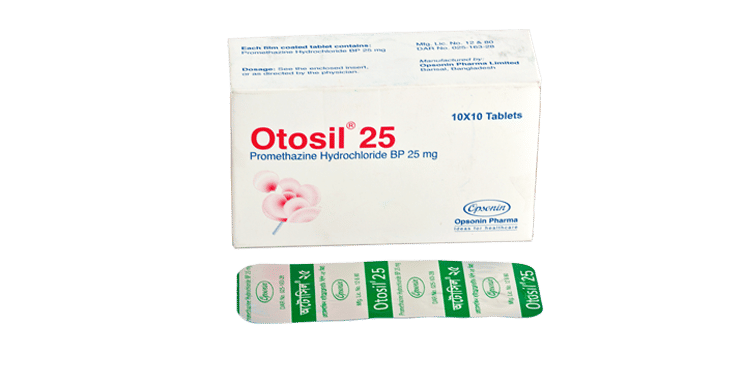
Otosil
Cheaper & Alternative Brands
Same generic (Promethazine Hydrochloride), same form (Tablet)

Clinical Prescribing Information
Medical monograph and safety information for healthcare professionals & patients.Indications & Clinical Uses
Allergan is indicated in-
Potent long-acting antihistamine with additional anti-emetic and sedative/calming effects.
Indicated in symptomatic treatment of allergic conditions of the respiratory tract and skin.
Sensitization reactions to drug or foreign proteins, anaphylactic reactions.
For sedation, allergic rhinitis, urticaria and insomnia.
As an adjunct in pre-operative sedation in surgery and obstetrics.
As a paediatric sedative
Dosage & Administration
Oral dose-
Adults: Initial dose one 25 mg tablet at night; may be increased to two or three 25 mg tablets at night if necessary. In allergic conditions more frequently administration, twice or three times daily, may be necessary, starting with one or two 10 mg tablets and increasing as required.
Elderly: No specific dosage recommendations.
Children: They may be treated more conveniently by the elixir containing 5 mg/5 ml.
As an antihistamine in allergy:
Children of 2-5 years: 5-15 mg
Children of 5-10 years: 10-25 mg
In the case where two doses in 24 hours are required, the lower dose stated should be given.
As a sedative:
Children of 2-5 years: 15-20 mg
Children of 5-10 years: 20-25 mg
Given as a single night-time dose
Parenteral dose
-
Adult: 25-50 mg by deep intramuscular injection or, in emergency, by slow intravenous injection after dilution of the 2.5% solution to 10 times its volume with water for injection. The maximum parenteral dose is 100 mg.
Children: 5-10 years: 6.25 to 12.5 mg by deep I.M. Injection
Contraindications
Promethazine is contraindicated for use in children less than two years of age
Hypersensitivity to promethazine or to any of the excipients.
Phenergan should not be used in patients who are in a coma or suffering from CNS depression of any cause. It must not be given to neonates or premature infants.
Phenergan should be avoided in patients who have been taking monoamine oxidase inhibitors within the previous 14 days
Side Effects & Adverse Reactions
Nervous system disorders: Frequency Unknown: Neuroleptic Malignant Syndrome the elderly are particularly susceptible to the anticholinergic efects and confusion due to Allergan, somnolence, dizziness, headaches, extrapyramidal efects including muscle spasm, tic-like movements of the head and face. A very serious and sometimes deadly health problem called neuroleptic malignant syndrome (NMS) may happen. Stop treatment and call your doctor right away if you have high fever, muscle cramps or stifness, dizziness, very bad headache, fast heartbeat, confusion, agitation, hallucinations, or are sweating a lot.
Immune System Disorders- Frequency unknown: Allergic reactions, including urticaria, rash, pruritus, and anaphylaxis, have been reported.
Skin and Subcutaneous Tissue Disorders- Frequency unknown: Photosensitivity reaction
Metabolism and Nutrition Disorders- Frequency unknown: Anorexia
Gastrointestinal Disorders- Frequency unknown: Epigastric discomfort, dry mouth
Eye Disorders- Frequency unknown: Blurred vision
Blood and Lymphatic System Disorders- Frequency unknown: Blood dyscrasias including hemolytic anemia, agranulocytosis
Renal and Urinary Disorders- Frequency unknown: Urinary retention
Psychiatric Disorders- Frequency unknown: Infants, newborns and premature are susceptible to the anticholinergic efects of promethazine, while other children may display paradoxical hyperexcitability, restlessness, nightmares, disorientation
Cardiac Disorders- Frequency unknown: Palpitations, arrhythmias
Vascular disorders- Frequency unknown: Hypotension
Hepatobiliary disorders- Frequency unknown: Jaundice
General Disorders and Administration Site Conditions- Frequency unknown: Tiredness
Use Allergan only as recommended. Do not exceed the recommended dose. There have been case reports of promethazine abuse. Do not take for longer than 10 days.
Warnings & Precautions
The use of promethazine should be avoided in children and adolescents with signs and symptoms suggestive of Reye’s syndrome.
Allergan may thicken or dry lung secretions and impair expectoration. It should therefore be used with caution in patients with asthma, bronchitis or bronchiectasis.
Use with care in patients with severe coronary artery disease.
Use with care in patients with narrow angle glaucoma.
Use with care in patients with epilepsy.
Use with care in patients with hepatic insufciency.
Use with care in patients with renal insufciency.
Caution should be exercised in patients with bladder neck obstruction.
Caution should be exercised in patients with pyloro-duodenal obstruction.
Pharmacology & Mechanism of Action
Promethazine is a phenothiazine derivative which blocks postsynaptic mesolimbic dopaminergic receptors in the brain. It exhibits strong α-adrenergic blocking effect and depresses the release of hypothalamic and hypophyseal hormones. It competes with histamine for the H1-receptor; muscarinic blocking effect may be responsible for antiemetic activity. It also reduces stimuli to the brainstem reticular system.
Promethazine is well absorbed from the gastrointestinal tract. Clinical effects are apparent within 20 minutes after oral administration and generally last four to six hours, although they may persist as long as 12 hours. Promethazine is metabolized by the liver to a variety of compounds; the sulfoxides of promethazine and N-demethylpromethazine are the predominant metabolites appearing in the urine.