
Nab-Paxel
Cheaper & Alternative Brands
Same generic (Nab-Paclitaxel [Nanoparticle Albumin-Bound Paclitaxel]), same form (IV Infusion)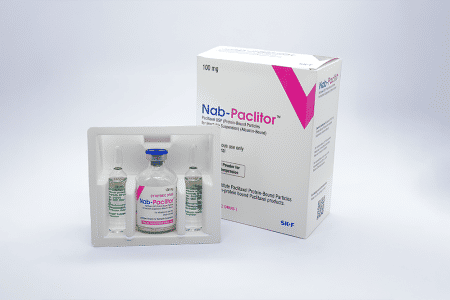

Clinical Prescribing Information
Medical monograph and safety information for healthcare professionals & patients.Indications & Clinical Uses
Metastatic Breast Cancer
: Nab-Paxel is indicated for the treatment of breast cancer after failure of combination chemotherapy for metastatic disease or relapse within 6 months of adjuvant chemotherapy. Prior therapy should have included an anthracycline unless clinically
... Read more
Metastatic Breast Cancer
: Nab-Paxel is indicated for the treatment of breast cancer after failure of combination chemotherapy for metastatic disease or relapse within 6 months of adjuvant chemotherapy. Prior therapy should have included an anthracycline unless clinically contraindicated.
Non-Small Cell Lung Cancer
: Nab-Paxel is indicated for the first-line treatment of locally advanced or metastatic non-small cell lung cancer, in combination with carboplatin, in patients who are not candidates for curative surgery or radiation therapy.
Adenocarcinoma Of The Pancreas
: Nab-Paxel is indicated for the first-line treatment of patients with metastatic adenocarcinoma of the pancreas, in combination with gemcitabine.
Dosage & Administration
Metastatic Breast Cancer
: After failure of combination chemotherapy for metastatic breast cancer or relapse within 6 months of adjuvant chemotherapy, the recommended regimen for Nab-Paclitaxel is 260 mg/m² administered intravenously over 30 minutes every 3 weeks.
Non-Small Cell Lung Cancer
: The recommended dose of Nab-Paclitaxel is 100 mg/m² administered as an intravenous infusion over 30 minutes on Days 1, 8, and 15 of each 21-day cycle. Administer carboplatin on Day 1 of each 21 day cycle immediately after Nab-Paclitaxel.
Adenocarcinoma Of The Pancreas
: The recommended dose of Nab-Paclitaxel is 125 mg/m² administered as an intravenous infusion over 30-40 minutes on Days 1, 8 and 15 of each 28-day cycle. Administer gemcitabine immediately after Nab-Paclitaxel on Days 1, 8 and 15 of each 28-day cycle.
Dosage In Patients With Hepatic Impairment
: For patients with mild hepatic impairment (total bilirubin greater than ULN and less than or equal to 1.5 x ULN and aspartate aminotransferase [AST] less than or equal to 10 x ULN), no dose adjustments are required, regardless of indication.
Do not administer Nab-Paclitaxel to patients with metastatic adenocarcinoma of the pancreas who have moderate to severe hepatic impairment. Do not administer Nab-Paclitaxel to patients with total bilirubin greater than 5 x ULN or AST greater than 10 x ULN regardless of indication as these patients have not been studied.
Contraindications
Nab-Paclitaxel should not be used in patients who have baseline neutrophil counts of <1,500 cells/mm³. Patients who experience a severe hypersensitivity reaction to Nab-Paclitaxel should not be rechallenged with the drug.
Side Effects & Adverse Reactions
The most common adverse reactions ( ≥20%) with single-agent use of Nab-Paxel in metastatic breast cancer are alopecia, neutropenia, sensory neuropathy, abnormal ECG, fatigue/asthenia, myalgia/arthralgia, AST elevation, alkaline phosphatase elevation, anemia, nausea, infections, and diarrhea.
The most common adverse reactions ( ≥20%) of Nab-Paxel in combination with carboplatin for non-small cell lung cancer are anemia, neutropenia, thrombocytopenia, alopecia, peripheral neuropathy, nausea, and fatigue.
The most common serious adverse reactions of Nab-Paxel in combination with carboplatin for non-small cell lung cancer are anemia (4%) and pneumonia (3%).
The most common adverse reactions resulting in permanent discontinuation of Nab-Paxel are neutropenia (3%), thrombocytopenia (3%), and peripheral neuropathy (1%).
The most common adverse reactions resulting in dose reduction of Nab-Paxel are neutropenia (24%), thrombocytopenia (13%), and anemia (6%).
The most common adverse reactions leading to withholding or delay in Nab-Paxel dosing are neutropenia (41%), thrombocytopenia (30%), and anemia (16%).
Pharmacology & Mechanism of Action
Nab-Paclitaxelis a microtubule inhibitor that promotes the assembly of microtubules from tubulin dimers and stabilizes microtubules by preventing depolymerization. This stability results in the inhibition of the normal dynamic reorganization of the microtubule network that is essential for vital interphase and mitotic cellular functions. Paclitaxel induces abnormal arrays or "bundles" of microtubules throughout the cell cycle and multiple asters of microtubules during mitosis.