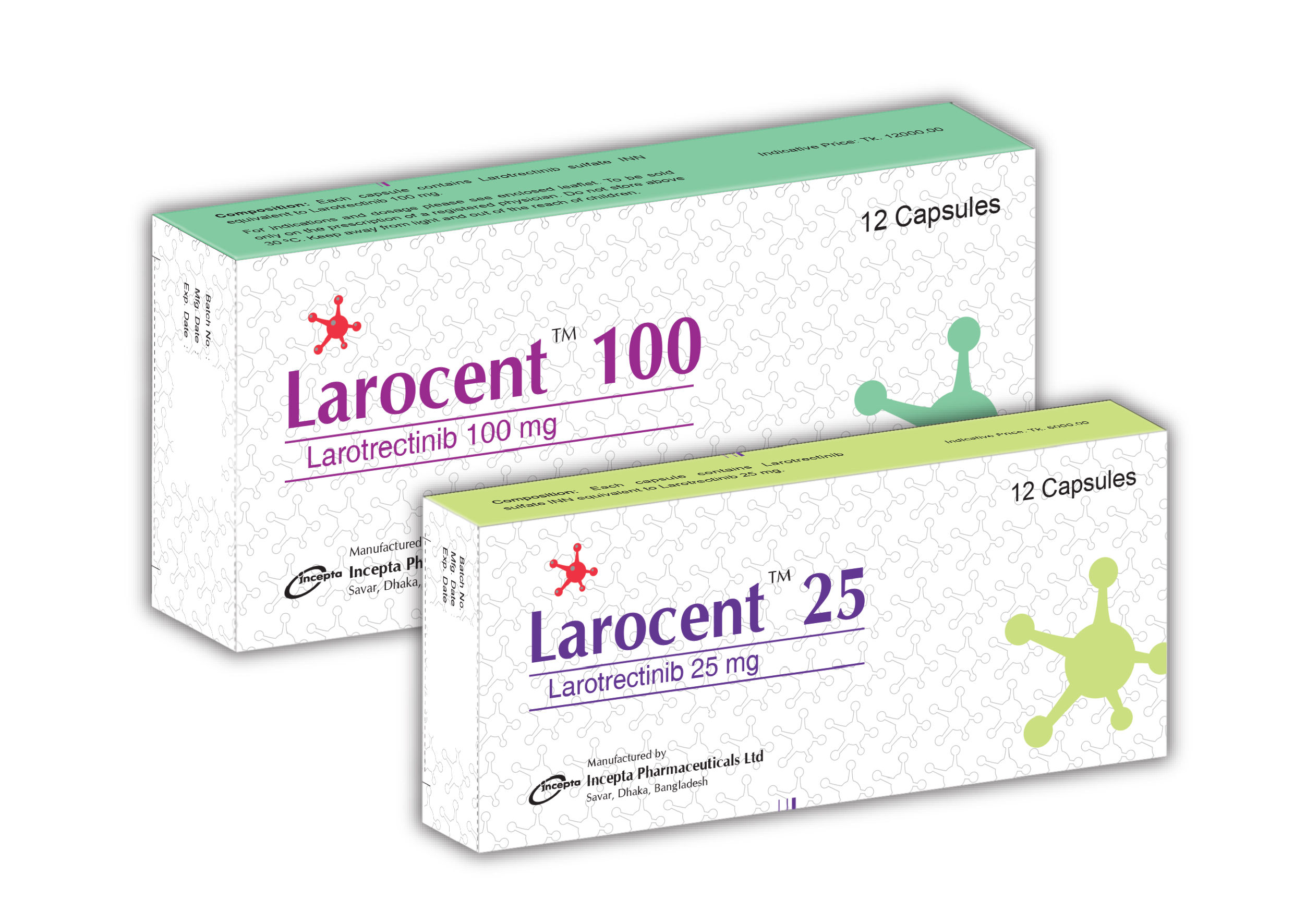
Larocent
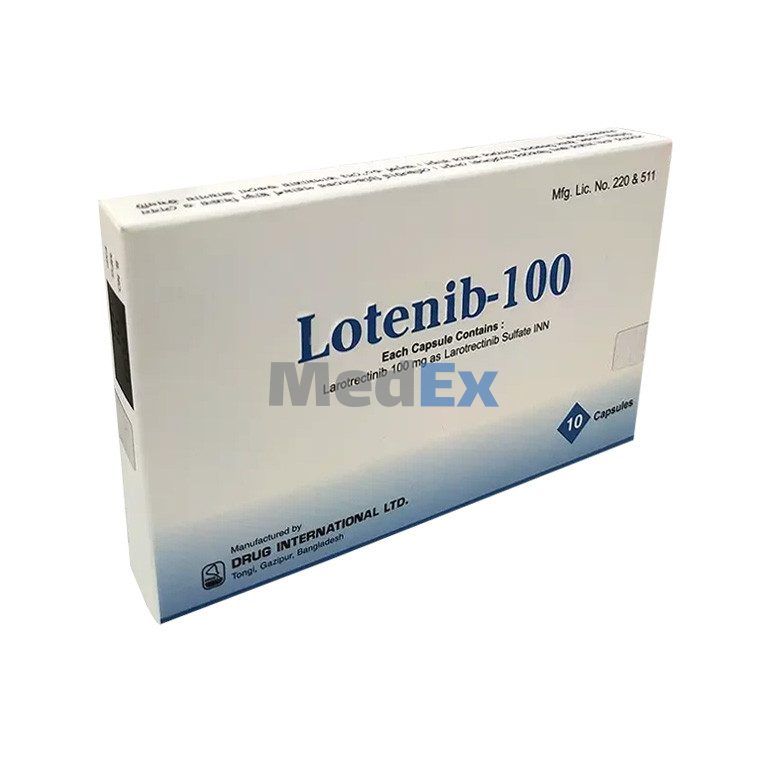
Cheaper & Alternative Brands
Same generic (Larotrectinib), same form (Capsule)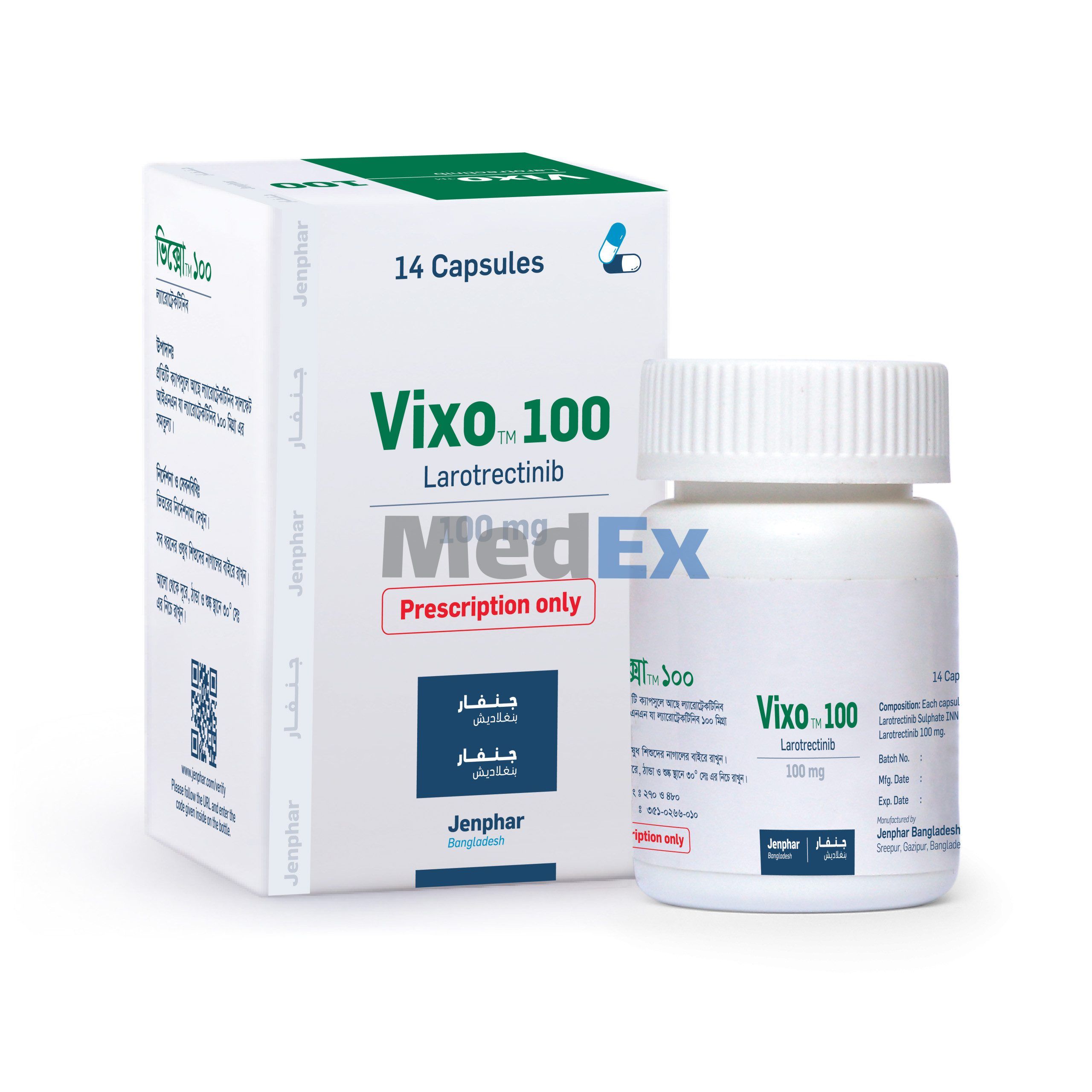
Clinical Prescribing Information
Medical monograph and safety information for healthcare professionals & patients.Indications & Clinical Uses
Larocent is indicated for the treatment of adult and pediatric patients with solid tumors that:
have a neurotrophic receptor tyrosine kinase (NTRK) gene fusion without a known acquired resistance mutation,
are metastatic or where surgical resection is likely to result in severe morbidity, and
have no satisfactory alternative treatments or that have progressed following treatment.
Dosage & Administration
Recommended Dosage in Adult and Pediatric Patients with Body Surface Area of at Least 1 m
2
: The recommended dosage of Larotrectinib is 100 mg orally twice daily, with or without food, until disease progression or until unacceptable toxicity.
Recommended Dosage in Pediatric Patients with Body Surface Area Less Than 1 m
2
: The recommended dosage of Larotrectinib is 100 mg/m
2
orally twice daily, with or without food, until disease progression or until unacceptable toxicity. Whole capsules should be swallowed with water and the capsules should not be chewed or crushed. A missed dose should not be made up within 6 hours of the next scheduled dose. If vomiting occurs after taking a dose of Larotrectinib, the next dose should be taken at the scheduled time. Or, as directed by the registered physicians.
Contraindications
It is contraindicated in patients with known hypersensitivity to Larotrectinib or any other components of this product.
Side Effects & Adverse Reactions
Common side effects are Neurotoxicity, Hepatotoxicity.
Warnings & Precautions
Neurotoxicity
: Among the 176 patients who received Larocent, neurologic adverse reactions of any grade occurred in 53% of patients, including Grade 3 and Grade 4 neurologic adverse reactions in 6% and 0.6% of patients, respectively. The majority (65%) of neurologic adverse reactions occurred within the first three months of treatment (range: 1 day to 2.2 years). Grade 3 neurologic adverse reactions included delirium (2%), dysarthria (1%), dizziness (1%), gait disturbance (1%), and paresthesia (1%). Grade 4 encephalopathy (0.6%) occurred in a single patient. Neurologic adverse reactions leading to dose modification included dizziness (3%), gait disturbance (1%), delirium (1%), memory impairment (1%), and tremor (1%). Patients and caretakers should be advised of these risks with Larocent. Patients should be advised not to drive or operate hazardous machinery if they are experiencing neurologic adverse reactions. Larocent should be withheld or permanently discontinued based on the severity. If withheld, Larocent dosage should be modified when resumed.
Hepatotoxicity
: Among the 176 patients who received Larocent, increased transaminases of any grade occurred in 45%, including Grade 3 increased AST or ALT in 6% of patients. One patient (0.6%) experienced Grade 4 increased ALT. The median time to onset of increased AST was 2 months (range: 1 month to 2.6 years). The median time to onset of increased ALT was 2 months (range: 1 month to 1.1 years). Increased AST and ALT leading to dose modifications occurred in 4% and 6% of patients, respectively. Increased AST or ALT led to permanent discontinuation in 2% of patients. Liver tests should be monitored, including ALT and AST, every 2 weeks during the first month of treatment, then monthly thereafter, and as clinically indicated. Larocent should be withheld or permanently discontinued based on the severity. If withheld, Larocent dosage should be modified when resumed.
Embryo-Fetal Toxicity
: Based on literature reports in human subjects with congenital mutations leading to changes in TRK signaling, findings from animal studies, and its mechanism of action, Larocent can cause fetal harm when administered to a pregnant woman. Women should be advised of the potential risk to a fetus. Females of reproductive potential should be advised to use an effective method of contraception during treatment and for 1 week after the final dose of Larocent.
Pharmacology & Mechanism of Action
Larotrectinib is an inhibitor of the tropomyosin receptor kinases (TRK), TRKA, TRKB, and TRKC. In a broad panel of purified enzyme assays, larotrectinib inhibited TRKA, TRKB, and TRKC with IC50 values between 5-11 nM. One other kinase TNK2 was inhibited at approximately 100-fold higher concentrations. TRKA, B, and C are encoded by the genes NTRK1, NTRK2, and NTRK3. Chromosomal rearrangements involving in-frame fusions of these genes with various partner scan result in constitutively activated chimeric TRK fusion proteins that can act as an oncogenic driver, promoting cell proliferation and survival in tumor cell lines.
Absorption
: The mean absolute bioavailability of Larotrectinib capsules was 34% (range: 32% to 37%).
Distribution
: The mean (CV%) volume of distribution (Vss) of Larotrectinib is 48 (38%) L following intravenous administration of Larotrectinib in healthy subjects. Larotrectinib is 70% bound to human plasma proteins in vitro and binding is independent of drug concentrations. The blood-to-plasma concentration ratio is 0.9.
Elimination
: The mean (CV%) clearance (CL/F) of Larotrectinib is 98 (44%) L/h and the half-life is 2.9 hours following oral administration of Larotrectinib in healthy subjects.
Metabolism
: Larotrectinib is metabolized predominantly by CYP3A4. Following oral administration of a single [14C] radiolabeled 100 mg dose of Larotrectinib to healthy subjects, unchanged Larotrectinib constituted 19% and an O-linked glucuronide constituted 26% of the major circulating radioactive drug components in plasma.
Excretion
: Following oral administration of a single [ 14 C] radiolabeled 100 mg dose of Larotrectinib to healthy subjects, 58% (5% unchanged) of the administered radioactivity was recovered in feces and 39% (20% unchanged) was recovered in urine.