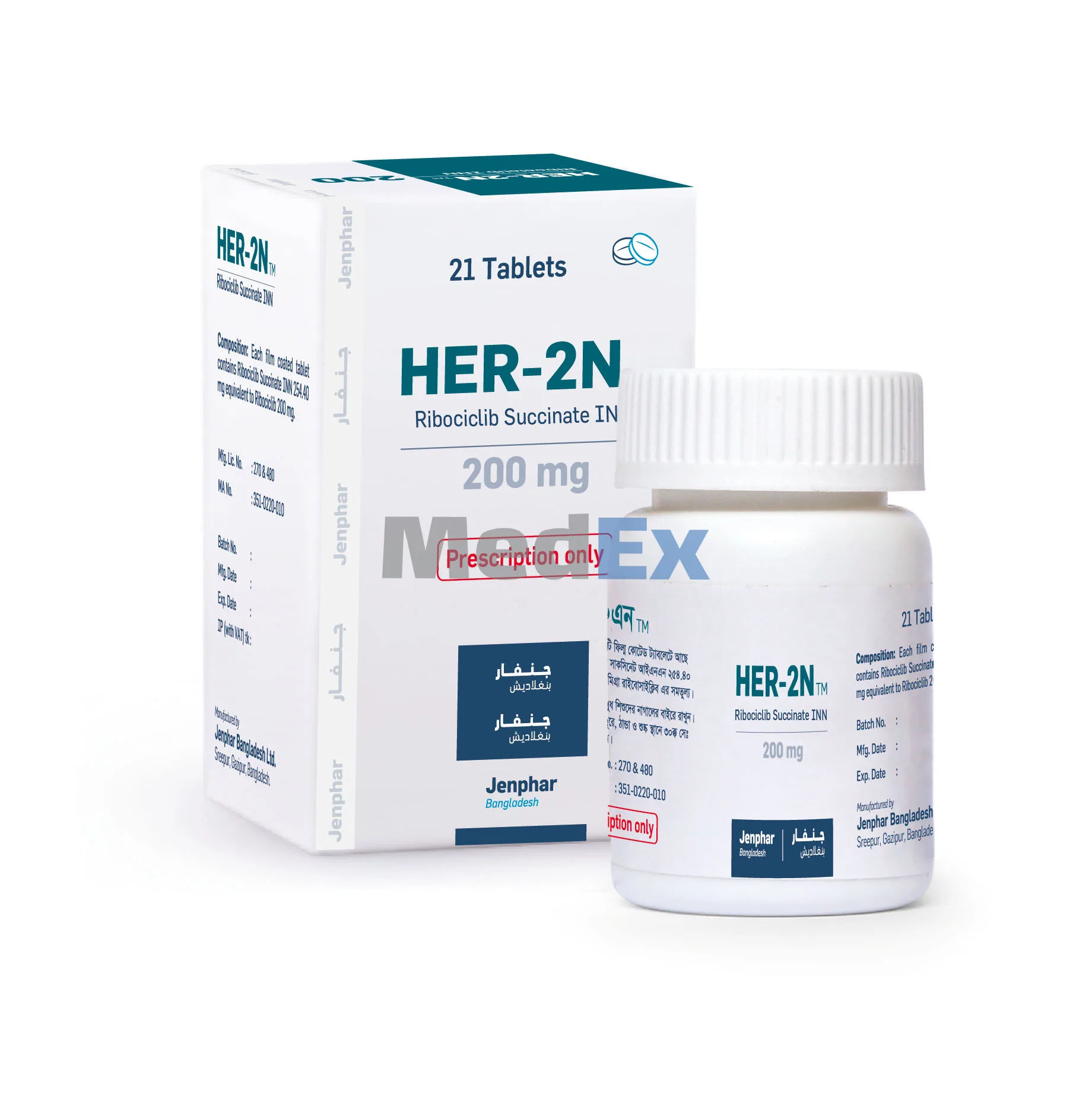
HER-2N
Cheaper & Alternative Brands
Same generic (Ribociclib), same form (Tablet)
Clinical Prescribing Information
Medical monograph and safety information for healthcare professionals & patients.Indications & Clinical Uses
HER-2N is a kinase inhibitor indicated for the treatment of adult patients with hormone receptor (HR)-positive, human epidermal growth factor receptor 2 (HER2)-negative advanced or metastatic breast cancer in combination with:
an aromatase inhibitor as initial endocrine-based therapy; or
fulvestrant as initial endocrine-based therapy or following disease progression on endocrine therapy in postmenopausal women or in men
Dosage & Administration
The recommended dose of Ribociclib is 600 mg taken orally, once daily for 21 consecutive days followed by 7 days off treatment resulting in a complete cycle of 28 days. Ribociclib can be taken with or without food.
Contraindications
Ribociclib is contraindicated in patients with known hypersensitivity to this product or any of its components.
Side Effects & Adverse Reactions
Most common adverse effects (incidence >20%) are neutropenia, nausea, infections, fatigue, diarrhea, leukopenia, vomiting, alopecia, headache, constipation, rash and cough.
Warnings & Precautions
Interstitial Lung Disease/Pneumonitis
: Severe, life-threatening, or fatal interstitial lung disease (ILD) and/or pneumonitis can occur in patients treated with HER-2N and other CDK4/6 inhibitors. Monitor patients for pulmonary symptoms indicative of ILD pneumonitis which may include hypoxia, cough and dyspnea.
Severe Cutaneous Adverse Reactions
: Severe cutaneous adverse reactions (SCARs), including Stevens-Johnson Syndrome (SJS), toxic epidermal necrolysis (TEN) and drug-induced hypersensitivity syndrome (DiHS)/drug reaction with eosinophilia and systemic symptoms (DRESS) can occur.
QT Interval Prolongation
: HER-2N has been shown to prolong the QT interval. Based on the observed QT prolongation during treatment HER-2N may require dose interruption, reduction or discontinuation. Monitor serum electrolytes (including potassium, calcium, phosphorous and magnesium) prior to the initiation of treatment at the beginning of the first 6 cycles and as clinically indicated.
Increased QT Prolongation with Concomitant Use of Tamoxifen
: HER-2N is not indicated for concomitant use with tamoxifen.
Hepatobiliary Toxicity
: Perform liver function tests (LFTs) before initiating therapy with HER-2N. Monitor LFTs every 2 weeks for first 2 cycles at the beginning of each subsequent 4 cycles and as clinically indicated. Based on the severity of the transaminase elevations, HER-2N may require dose interruption, reduction or discontinuation.
Neutropenia
: Perform complete blood count (CBC) before initiating therapy with HER-2N. Monitor CBC every 2 weeks for the first 2 cycles, at the beginning of each subsequent 4 cycles and as clinically indicated. Based on the severity of the neutropenia, HER-2N may require dose interruption, reduction or discontinuation.
Embryo-Fetal Toxicity
: Based on findings from animal studies and the mechanism of action, HER-2N can cause fetal harm when administered to a pregnant woman. Advise women of reproductive potential to use effective contraception during therapy with HER-2N and for at least 3 weeks after the last dose.
Pharmacology & Mechanism of Action
Ribociclib is an inhibitor of cyclin-dependent kinase (CDK) 4 and 6. These kinases are activated upon binding to D-cyclins and play a crucial role in signaling pathways which lead to cell cycle progression and cellular proliferation. The cyclin D-CDK4/6 complex regulates cell cycle progression through phosphorylation of the retinoblastoma protein (pRb). In vitro, ribociclib decreased pRb phosphorylation leading to arrest in the G1 phase of the cell cycle and reduced cell proliferation in breast cancer cell lines. In vivo, treatment with single agent ribociclib in a rat xenograft model with human tumor cells led to decreased tumor volumes, which correlated with inhibition of pRb phosphorylation. In studies using patient-derived estrogen receptor positive breast cancer xenograft models, combination of ribociclib and antiestrogen (e.g., letrozole) resulted in increased tumor growth inhibition compared to each drug alone. Additionally, the combination of ribociclib and fulvestrant resulted in tumor growth inhibition in an estrogen receptor positive breast cancer xenograft model.