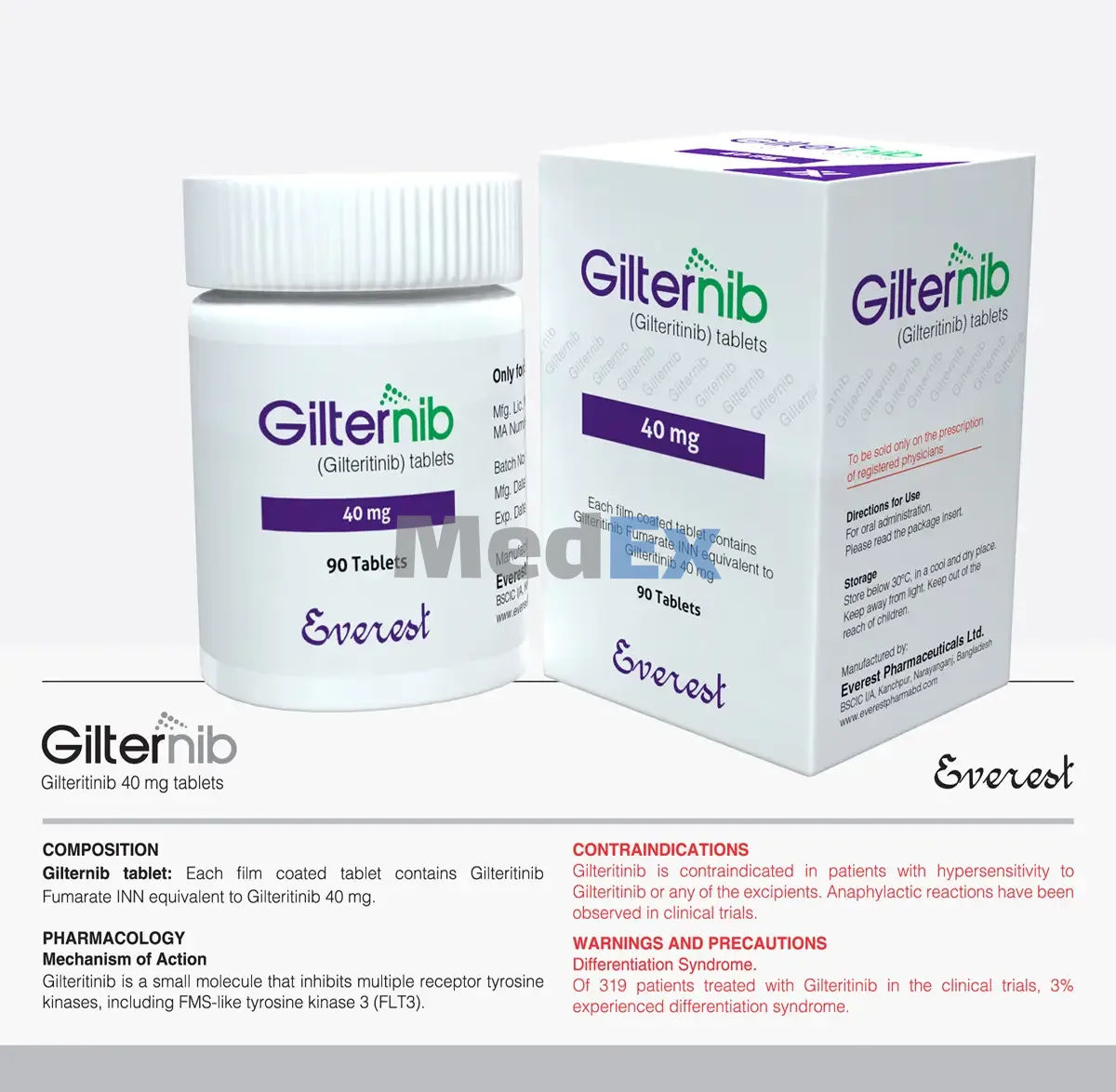
Gilternib
Cheaper & Alternative Brands
Same generic (Gilteritinib Fumarate), same form (Tablet)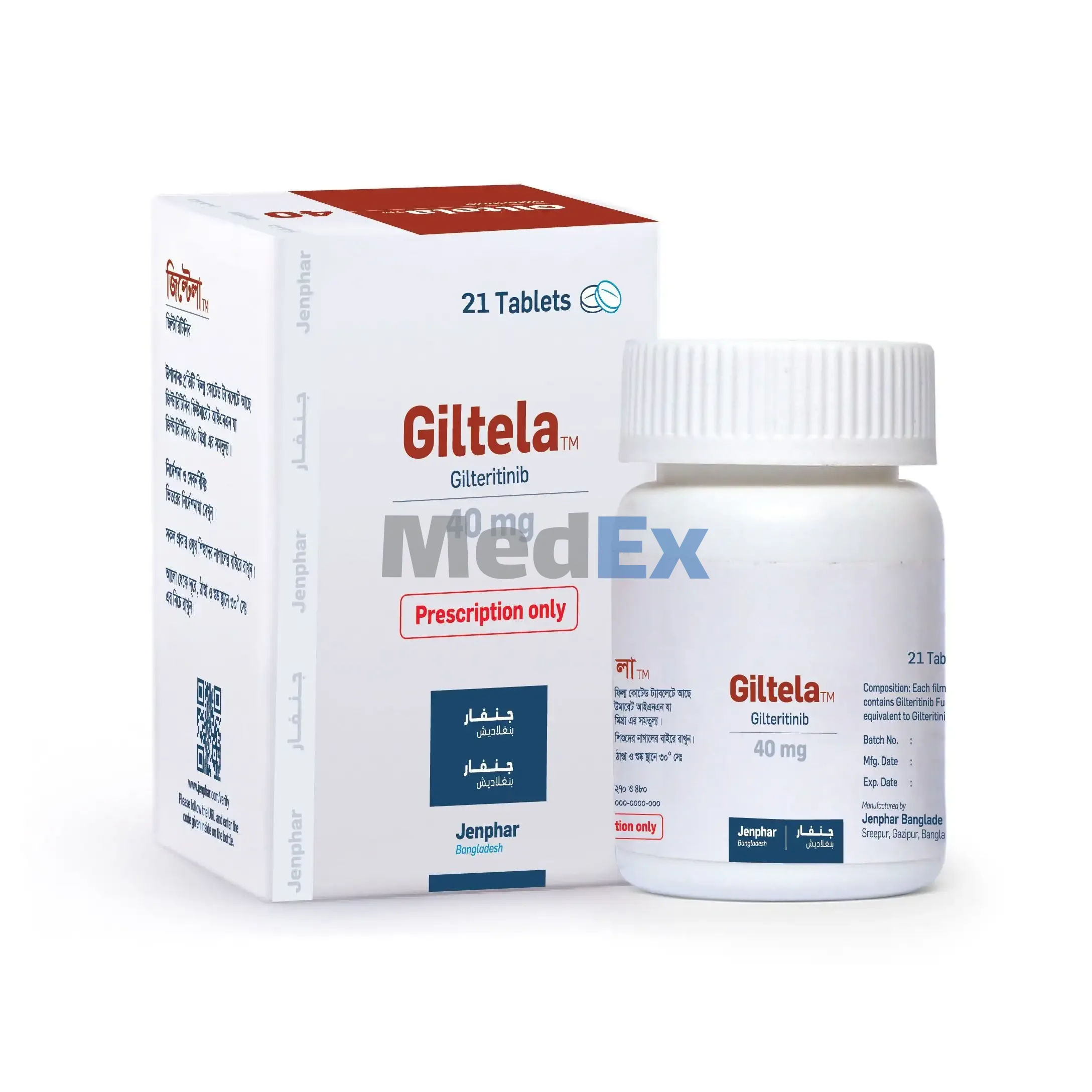
Clinical Prescribing Information
Medical monograph and safety information for healthcare professionals & patients.Indications & Clinical Uses
Giltela is indicated for the treatment of adult patients who have relapsed or refractory acute myeloid leukemia (AML) with a FMS-like tyrosine kinase 3 (FLT3) mutation as detected by an FDA-approved test.
Dosage & Administration
Patient Selection
: Select patients for the treatment of AML with Gilteritinib based on the presence of FLT3 mutations in the blood or bone marrow. Information on FDA-approved tests for the detection of a FLT3 mutation in AML is available.
Recommended Dosage
: The recommended starting dose of Gilteritinib is 120 mg orally once daily with or without food. Response may be delayed. In the absence of disease progression or unacceptable toxicity, treatment for a minimum of 6 months is recommended to allow time for a clinical response. Do not break or crush Gilteritinib tablets. Administer Gilteritinib tablets orally about the same time each day. If a dose of Gilteritinib is missed or not taken at the usual time, administer the dose as soon as possible on the same day, and at least 12 hours prior to the next scheduled dose. Return to the normal schedule the following day. Do not administer 2 doses within 12 hours.
Dose Modification
: Assess blood counts and blood chemistries, including creatine phosphokinase, prior to the initiation of Gilteritinib, at least once weekly for the first month, once every other week for the second month, and once monthly for the duration of therapy. Perform electrocardiogram (ECG) prior to initiation of treatment with Gilteritinib, on days 8 and 15 of cycle 1, and prior to the start of the next two subsequent cycles.
Contraindications
Gilteritinib is contraindicated in patients with hypersensitivity to Gilteritinib or any of the excipients. Anaphylactic reactions have been observed in clinical trials.
Side Effects & Adverse Reactions
The following adverse drug reactions are described elsewhere in the labeling:
Fever
Dizziness or lightheadedness
Cough
Rapid weight gain
Trouble breathing
Swelling of your arms or legs
Rash
Decreased urination
Warnings & Precautions
Differentiation Syndrome
: Of 319 patients treated with Giltela in the clinical trials, 3% experienced differentiation syndrome. Differentiation syndrome is associated with rapid proliferation and differentiation of myeloid cells and may be life-threatening or fatal if not treated. Symptoms of differentiation syndrome in patients treated with Giltela included fever, dyspnea, pleural effusion, pericardial effusion, pulmonary edema, hypotension, rapid weight gain, peripheral edema, rash, and renal dysfunction. Some cases had concomitant acute febrile neutrophilic dermatosis. Differentiation syndrome occurred as early as 2 days and up to 75 days after Giltela initiation and has been observed with or without concomitant leukocytosis. Of the 11 patients who experienced differentiation syndrome, 9 (82%) recovered after treatment or after dose interruption of Giltela. If differentiation syndrome is suspected, initiate dexamethasone 10 mg IV every 12 hours (or an equivalent dose of an alternative oral or IV corticosteroid) and hemodynamic monitoring until improvement. Taper corticosteroids after resolution of symptoms and administer corticosteroids for a minimum of 3 days. Symptoms of differentiation syndrome may recur with premature discontinuation of corticosteroid treatment. If severe signs and/or symptoms persist for more than 48 hours after initiation of corticosteroids, interrupt Giltela until signs and symptoms are no longer severe.
Posterior Reversible Encephalopathy Syndrome
: Of 319 patients treated with Giltela in the clinical trials, 1% experienced posterior reversible encephalopathy syndrome (PRES) with symptoms including seizure and altered mental status. Symptoms have resolved after discontinuation of Giltela. A diagnosis of PRES requires confirmation by brain imaging, preferably magnetic resonance imaging (MRI). Discontinue Giltela in patients who develop PRES.
Prolonged QT Interval
: Giltela has been associated with prolonged cardiac ventricular repolarization (QT interval). Of the 317 patients with a post-baseline QTc measurement on treatment with Giltela in the clinical trial, 1% were found to have a QTc interval greater than 500 msec and 7% of patients had an increase from baseline QTc greater than 60 msec. Perform electrocardiogram (ECG) prior to initiation of treatment with
Giltela, on days 8 and 15 of cycle 1, and prior to the start of the next two subsequent cycles. Interrupt and reduce Giltela dosage in patients who have a QTcF >500 msec. Hypokalemia or hypomagnesemia may increase the QT prolongation risk. Correct hypokalemia or hypomagnesemia prior to and during Giltela administration.
Pancreatitis
: Of 319 patients treated with Giltela in the clinical trials, 4% experienced pancreatitis. Evaluate patients who develop signs and symptoms of pancreatitis. Interrupt and reduce the dose of Giltela in patients who develop pancreatitis.
Embryo-Fetal Toxicity
: Based on findings in animals and its mechanism of action, Giltela can cause embryo-fetal harm when administered to a pregnant woman. In animal reproduction studies, administration of Giltela to pregnant rats during organogenesis caused embryo-fetal lethality, suppressed fetal growth and teratogenicity at maternal exposures (AUC24) approximately 0.4 times the AUC24 in patients receiving the recommended dose. Advise females of reproductive potential to use effective contraception during treatment with Giltela and for at least 6 months after the last dose of Giltela. Advise males with female partners of reproductive potential to use effective contraception during treatment with Giltela and for at least 4 months after the last dose of Giltela. Pregnant women, patients becoming pregnant while receiving Giltela or male patients with pregnant female partners should be apprised of the potential risk to the fetus.
Pharmacology & Mechanism of Action
Gilteritinib is a small molecule that inhibits multiple receptor tyrosine kinases, including FMS-like tyrosine kinase 3 (FLT3). Gilteritinib demonstrated the ability to inhibit FLT3 receptor signaling and proliferation in cells exogenously expressing FLT3 including FLT3-ITD, tyrosine kinase domain mutations (TKD) FLT3-D835Y and
FLT3-ITD-D835Y, and it induced apoptosis in leukemic cells expressing FLT3-ITD.
Pharmacodynamics: In patients with relapsed or refractory AML administered Gilteritinib 120 mg, substantial (>90%) inhibition of FLT3 phosphorylation was rapid (within 24 hours after first dose) and sustained, as characterized by an ex vivo plasma inhibitory activity (PIA) assay.