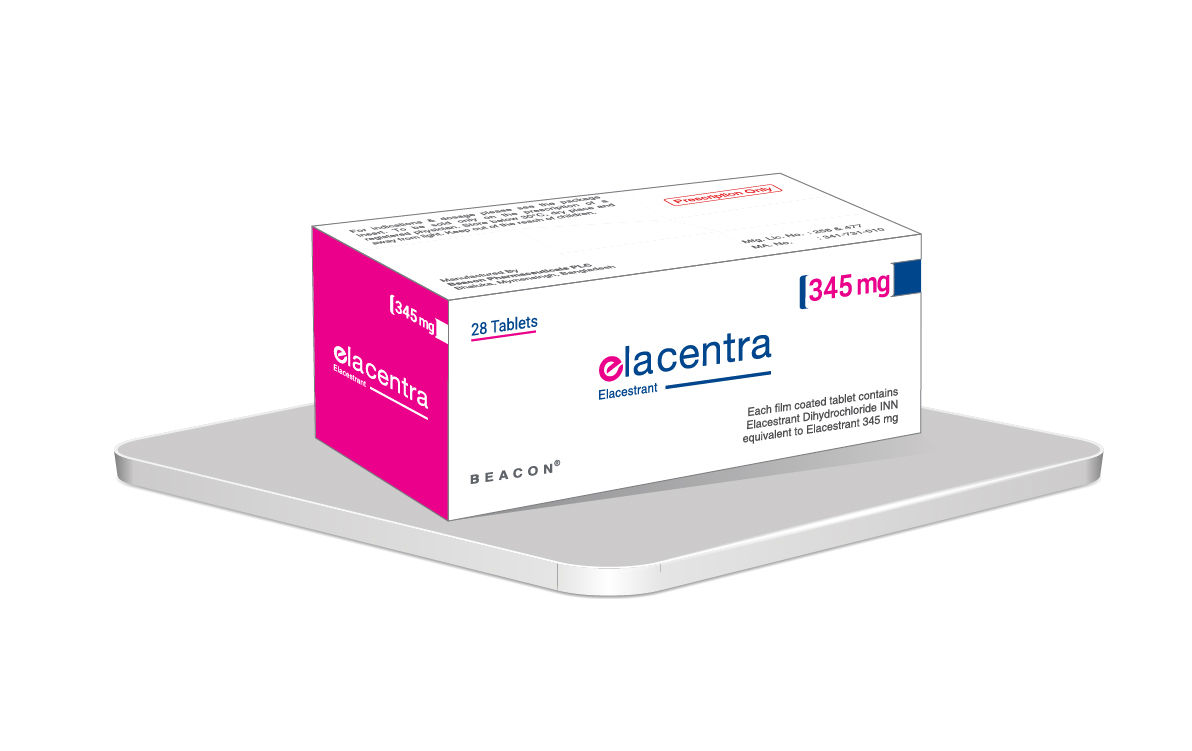
Elacentra
Cheaper & Alternative Brands
Same generic (Elacestrant), same form (Tablet)Clinical Prescribing Information
Medical monograph and safety information for healthcare professionals & patients.Indications & Clinical Uses
Elacentra is an estrogen receptor antagonist indicated for: treatment of postmenopausal women or adult men, with ERpositive, HER2-negative, ESR1-mutated advanced or metastatic breast cancer with disease progression following at least one line of endocrine therapy.
Dosage & Administration
Patient Selection: Select patients for treatment of ER-positive, HER2-negative advanced or metastatic breast cancer with
Elacestrant based on the presence of ESR1 mutation(s) in plasma specimen using an FDA-approved test.
Recommended Dosage: The recommended dosage of Elacestrant is 345 mg taken orally with food once daily until disease progression or unacceptable toxicity occurs. Take Elacestrant at approximately the same time each day. Take with food t reduce nausea and vomiting. Swallow Elacestrant tablet(s) whole. Do not chew, crush, or split prior to swallowing. Do not take any Elacestrant tablets that are broken, cracked, or that look damaged. If a dose is missed for more than 6 hours or vomiting occurs, skip the dose and take the next dose the following day at its regularly scheduled time.
Side Effects & Adverse Reactions
The most common (>10%) adverse reactions, including laboratory abnormalities, of Elacentra were musculoskeletal pain, nausea, increased cholesterol, increased AST, increased triglycerides, fatigue, decreased hemoglobin, vomiting, increased ALT, decreased sodium, increased creatinine, decreased appetite, diarrhea, headache, constipation, abdominal pain, hot flush, and dyspepsia.
Warnings & Precautions
Dyslipidemia
: Hypercholesterolemia and hypertriglyceridemia occurred in patients taking Elacentra at an incidence of 30% and 27%, respectively. The incidence of Grade 3 and 4 hypercholesterolemia and hypertriglyceridemia were 0.9% and 2.2%, respectively.
Embryo-Fetal Toxicity
: Based on findings in animals and its mechanism of action, Elacentra can cause fetal harm when administered to a pregnant woman. Administration of Elacentra to pregnant rats resulted in adverse developmental outcomes, including embryo-fetal mortality and structural abnormalities, at maternal exposures below the recommended dose based on area under the curve (AUC). Advise pregnant women and females of reproductive potential of the potential risk to a fetus. Advise females of reproductive potential to use effective contraception during treatment with Elacentra and for 1 week after the last dose. Advise male patients with female partners of reproductive potential to use effective contraception during treatment with Elacentra and for 1 week after the last dose.
Pharmacology & Mechanism of Action
Elacestrant is an estrogen receptor antagonist that binds to estrogen receptor-alpha (ERα). In ERpositive (ER+) HER2-negative (HER2-) breast cancer cells, elacestrant inhibited 17β-estradiol mediated cell proliferation at concentrations inducing degradation of ERα protein mediated through proteasomal pathway. Elacestrant demonstrated in vitro and in vivo antitumor activity including in ER+ HER2- breast cancer models resistant to fulvestrant and cyclin-dependent kinase 4/6 inhibitors and those harboring estrogen receptor 1 gene (ESR1) mutations.