
Dixanol
Cheaper & Alternative Brands
Same generic (Iodixanol), same form (Injection)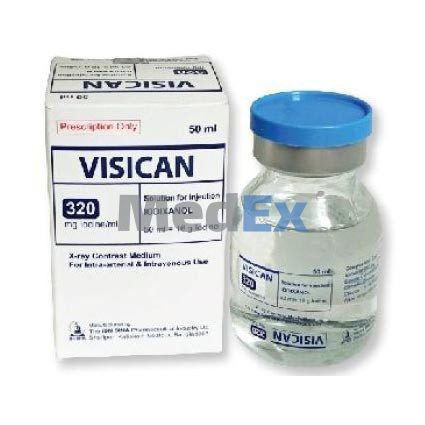
Clinical Prescribing Information
Medical monograph and safety information for healthcare professionals & patients.Indications & Clinical Uses
Dixanol injection is a radiographic contrast agent indicated for the following:
Intra-arterial Procedures:
Adults and pediatric patients 12 years of age and over:
Intra-arterial digital subtraction angiography (270 and 320 mg Iodine/mL).
Angiocardiography (left ventriculography and selective coronary arteriography), peripheral arteriography, visceral arteriography, and cerebral arteriography (320 mg Iodine/mL).
... Read more
Dixanol injection is a radiographic contrast agent indicated for the following:
Intra-arterial Procedures:
Adults and pediatric patients 12 years of age and over:
Intra-arterial digital subtraction angiography (270 and 320 mg Iodine/mL).
Angiocardiography (left ventriculography and selective coronary arteriography), peripheral arteriography, visceral arteriography, and cerebral arteriography (320 mg Iodine/mL).
Pediatric patients less than 12 years of age:
Angiocardiography, cerebral arteriography, and visceral arteriography (320 mg Iodine/mL).
Intravenous Procedures:
Adults and pediatric patients 12 years of age and over:
Computed tomography (CT) imaging head and body and excretory urography (270 and 320 mg Iodine/mL).
CT imaging peripheral venography (270 mg Iodine/mL).
Coronary computed tomography angiography (CCTA) to assist diagnostic evaluation of patients with suspected coronary artery disease (320 mg Iodine/mL).
Pediatric patients less than 12 years of age:
CT imaging of the head and body and excretory urography (270 mg Iodine/mL).
Dosage & Administration
Adult Dosage:
Intra-arterial use: (Concentration 270/320 mg I/ml)
Arteriographies: 5-10 ml per inj.Selective cerebral: 40-60 ml per inj.
Aortography peripheral: 30-60 ml per inj.
Angiocardiography: (Concentration 320 mg I/ml)
Left ventricle and aortic root: 30-60 ml per inj.
Selective coronary arteriography: 4-8 ml per inj.
Intravenous use: (Concentration 270/320 mg I/ml)
Urography
CT-enhancement: 40-80 ml
CT of the body: 50-150 ml
CT of the head: 75-150 ml
Paediatric Dosage:
Intra-arterial use: (Concentration 320 mg I/ml)
Cardioangiography: 1-2 ml/kg with max recommended dose of 10 ml/kg.
All doses depending on age, weight and pathology.
Intravenous use: (Concentration 270/320 mg I/ml)
Urography
Children & lt;7: kg 2-3 ml/kg up to 50 ml (in a few cases up to 150 ml may be given)
Children & gt;7: kg 2-3 ml/kg up to 50 ml (in a few cases up to 150 ml may be given)
CT-enhancement: (Concentration 270/320 mg I/ml)CT of the body &
Body: 2-3 ml/kg up to 50 ml (in a few cases up to 150 ml may be given)
Upper Gastrointestinal Studies Children: (Concentration 320 mg I/ml) the dosage must be adjusted individually to allow optimal visualization 5 ml/kg b.w. 10-240 ml has been studied.
Contraindications
Iodixanol Injection is not indicated for intrathecal use. In the pediatric population prolonged fasting and the administration of a laxative before Visican injection are contraindicated.
Side Effects & Adverse Reactions
Most common adverse reactions (incidence greater than 0.5%) in adult patients after Dixanol injection: Discomfort, warmth, pain.Cardiovascular: angina. Gastrointestinal: diarrhea, nausea, vomiting. Nervous System: agitation, anxiety, insomnia, nervousness, dizziness, headache, migraine, unusual skin sensations, sensory disturbance, fainting, sensation of spinning. Skin: itchy rash, severe itching, hives. Special Senses: Smell, taste, and vision alteration. Pediatric patients experienced similar adverse reactions
Warnings & Precautions
Precautions for use of non-ionic contrast media in general: The risk of serious reactions in connection with use of Visican is regarded as minor. However, iodinated contrast media may provoke anaphylactoid reactions or other manifestations of hypersensitivity. A course of action should therefore be planned in advance, with necessary drugs and equipment available for immediate treatment, should a serious reaction occur. It is advisable always to use an indwelling cannula or catheter for quick intravenous access throughout the entire X-ray procedure. As with other iodinated contrast agents, the use of Visican injection contrast enhancement may obscure some lesions which are seen on previously unenhanced CT scans. In patients with normal blood-brain barriers and renal failure, iodinated contrast agents have been associated with blood-brain barrier disruption and accumulation of contrast in the brain. Enhancement of the inferior vermis following contrast agent administration has resulted in false positive diagnosis. Hydration Patients should be well hydrated prior to, and following, administration of any contrast medium, including Visican, in order to prevent from acute renal failure. This applies especially to patients with multiple myeloma, diabetes mellitus, renal dysfunction and elderly patients. Preparatory dehydration is dangerous and may contribute to acute renal failure in patients with pre-existing renal insufficiency, diabetes or advanced vascular disease. It is believed that overnight fluid restriction prior to excretory urography generally does not provide better visualization in normal patients.
To avoid contrast induced nephropathy, the following should be considered:
Identification of high risk patients
Ensuring adequate hydration. The patient should be hydrated (e.g. at least 100 ml per hour of soft drinks or intravenous saline up to 24 hours after contrast medium administration. In warm areas more fluid should be given).
If necessary by maintaining an i.v. infusion from before the procedure until the contrast medium has been cleared by the kidneys. Avoiding additional strain on the kidneys in the form of nephrotoxic drugs, oral cholecystography agents, arterial clamping, renal arterial angioplasty, or major surgery, until the contrast medium has been cleared.
Postponing a repeat contrast medium examination until renal function returns to preexamination levels.
Monitor renal function (serum creatinine), serum lactic acid and pH of blood.
Look for symptoms of lactic acidosis (vomiting, somnolence, nausea, epigastric pain, anorexia, hyperpnea, lethargy, diarrhoea and thirst).
Pharmacology & Mechanism of Action
Intravascular injection of iodixanol opacifies vessels in the path of flow of the contrast agent, permitting visualization of internal structures. In imaging of the body, iodinated contrast agents diffuse from the vascular into the extravascular space. In a normal brain with an intact blood-brain barrier, contrast does not diffuse into the extravascular space. In patients with a disrupted bloodbrGeneral Iodixanol is a dimeric, isosmolar, nonionic, water soluble, and Iodinated x-ray contrast agent for intravascular administration. Intravascular injection of Iodixanol opacifies those vessels in the path of flow of the contrast agent, permitting radiographic visualization of the internal structures until significant dilution and elimination occurs.
Pharmacokinetics
: Distribution In an in vitro human plasma study, Iodixanol did not bind to protein. The volume of distribution was 0.26 liky body weight, consistent with distribution to extracellular space. Metabolism Iodixanol metabolites have not been demonstrated. Excretion Plasma and urine levels suggest that body clearance of Iodixanol is primarily due to renal clearance. In adults, approximately 97% of the injected dose of Iodixanol is excreted unchanged in urine within 24 hours, with less than 2% excreted in feces within five days post-injection.
Pharmacodynamics
: As with other iodinated contrast agents, following administration of Visican Injection, the degree of enhancement is directly related to the iodine content in an administered dose; peak iodine plasma levels occur immediately following rapid intravascular injection. Iodine plasma levels fall rapidly within 5 to 10 minutes. This can be accounted for by the dilution in the vascular and extravascular fluid compartments.ain barrier, contrast agent accumulates in the interstitial space in the region of disruption.