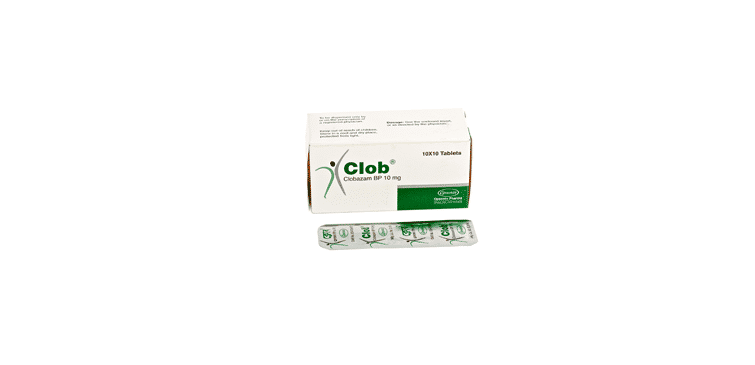
Clob
Cheaper & Alternative Brands
Same generic (Clobazam), same form (Tablet)

Clinical Prescribing Information
Medical monograph and safety information for healthcare professionals & patients.Indications & Clinical Uses
Acute and chronic anxiety states which may produce the following symptoms in particular: anxiety, tension, restlessness, excitement, irritability, sleep disturbances from emotional causes, psychovegetative and psychosomatic disorders (for example, in the cardiovascular or gastrointestinal area), and
... Read more
Acute and chronic anxiety states which may produce the following symptoms in particular: anxiety, tension, restlessness, excitement, irritability, sleep disturbances from emotional causes, psychovegetative and psychosomatic disorders (for example, in the cardiovascular or gastrointestinal area), and emotional instability.
In patients with depression or anxiety associated with depression, Calm must be used only in conjunction with adequate concomitant treatment. Use of benzodiazepines alone, can precipitate suicide in such patients. Before treatment of anxiety states associated with emotional instability, it must first be determined whether the patient suffers from a depressive disorder requiring adjunctive or different treatment.
In patients with schizophrenic or other psychotic illnesses, use of benzodiazepines is recommended only for adjunctive, i.e. not for primary treatment.
As adjunctive therapy in patients with epilepsy who are not adequately stabilized with their anticonvulsant monotherapy.
Contraindications
Clobazam must not be used-
In patients with hypersensitivity to clobazam or any of the excipients of Clobazam.
In patients with myasthenia gravis (risk of aggravation of muscle weakness).
In patients with severe respiratory insufciency (risk of deterioration).
In patients with sleep apnoea syndrome (risk of deterioration).
In patients with severe impairment of liver function (risk of precipitating encephalopathy).
In breast-feeding women Benzodiazepines must not be given to children without careful assessment of the need for their use.
Clobazam must not be used in children between the ages of 6 months and 3 years, other than in exceptional cases for anticonvulsant treatment where there is a compelling indication.
Side Effects & Adverse Reactions
Metabolism and nutrition disorders
: Common: decreased appetite
Psychiatric disorders
: Common: irritability, aggression, restlessness, depression (pre-existing depression may be unmasked), drug tolerance (especially during prolonged use), agitation.
Nervous system disorders
: Very common: somnolence, especially at the beginning of treatment and when higher doses are used; Common: sedation, dizziness, disturbance in attention, slow speech/dysarthria/ speech disorder (particularly with high doses or in long-term treatment, and are reversible), headache, tremor, ataxia.
Eye Disorders
: Uncommon: diplopia (particularly with high doses or in long-term treatment and is reversible)
Respiratory, thoracic and mediastinal disorders
: Not known: respiratory depression respiratory failure (particularly in patients with pre-existing compromised respiratory function e.g. in patients with bronchial asthma or brain damage)
Gastrointestinal disorders
: Common: dry mouth, nausea, constipation
Skin and subcutaneous disorders
: Uncommon: rash; Not known: photosensitivity reaction urticaria; Steven Johnson syndrome, toxic epidermal necrolysis (including some cases with fatal outcome);
Musculoskeleteal and connective tissue disorders
: Not known: muscle spasms, muscle weakness
General disorders and administration site conditions
: Very common: fatigue, especially at the beginning of treatment and when higher doses are used. Not known: slow response to stimuli, hypothermia
Investigations
: Uncommon: weight increased (particularly with high doses or in long-term treatment).
Warnings & Precautions
Serious Skin Reactions
: Serious skin reactions, including Stevens-Johnson syndrome (SJS) and toxic epidermal necrolysis (TEN), have been reported with Calm in both children and adults during the post-marketing experience. A majority of the reported cases involved the concomitant use of other drugs, including antiepileptic drugs that are associated with serious skin reactions. SJS/TEN could be associated with a fatal outcome. Patients should be closely monitored for signs or symptoms of SJS/TEN, especially during the first 8 weeks of treatment. Calm should be immediately discontinued when SJS/TEN is suspected. If signs or symptoms suggest SJS/TEN, use of Calm should not be resumed and alternative therapy should be considered.
Respiratory depression
: Calm can cause respiratory depression, especially if administered in high doses. Therefore in patients with chronic or acute respiratory insufficiency, respiratory function must be monitored and a dose reduction may be necessary. Calm is contraindicated in patients with severe respiratory insufficiency.
Muscle weakness
: Calm can cause muscle weakness. Calm is contraindicated in patients with myasthenia gravis.
Renal and hepatic impairment
: In patients with impairment of renal or hepatic function, responsiveness to Calm and susceptibility to adverse effects are increased, and a dose reduction may be necessary. In long-term treatment, renal and hepatic function must be checked regularly.
Elderly patients
: In the elderly, due to the increased sensitivity to adverse reactions such as drowsiness, dizziness, muscle weakness, there is an increased risk of fall that may result in serious injury. A dose reduction is recommended.
Tolerance in epilepsy
: In the treatment of epilepsy with benzodiazepines- including Calm, consideration must be given to the possibility of a decrease in anticonvulsant efficacy (development of tolerance) in the course of treatment.
CYP2C19 poor metabolizers
: In patients who are CYP2C19 poor metabolizers, levels of the active metabolite N-desmethylCalm are expected to be increased as compared to extensive metabolizers. Dosage adjustment of Calm may be necessary (e.g. low starting dose with careful dose titration).
Suicidality
: Several epidemiological studies show an increased incidence of suicide and suicide attempt in patients with or without depression, treated with other benzodiazepines and hypnotics. There are very limited data available for Calm in these studies. Cases of suicidal behavior have been reported with Calm in post-marketing surveillance. All of these cases had confounding factors.
Concomitant use of CYP2C19 inhibitors
: The concomitant use of Calm with CYP2C19 inhibitors, including cannabidiol containing medicinal products, dietary supplements and recreational products may result in increased exposure to N-desmethylCalm (NCLB). Such increases might lead to increased adverse effects, such as somnolence and sedation. When used with medicinal products that are CYP2C19 inhibitors dosage adjustment of Calm may be necessary. Dietary supplements and recreational products containing cannabidiol must not be taken in combination with Calm as they contain unknown quantities of cannabidiol and are of variable quality
Pharmacology & Mechanism of Action
Clobazam binds at distinct binding sites associated with the chloride ionopore at the post-synaptic GABA receptor. These GABA receptors are in various locations in the CNS (limbic, reticular formation) and clobazam increases the duration of time for which the chloride ionopore is open. As a result, hyper polarization and stabilization of the membrane occur as the post-synaptic inhibitory effect of GABA is enhanced.