
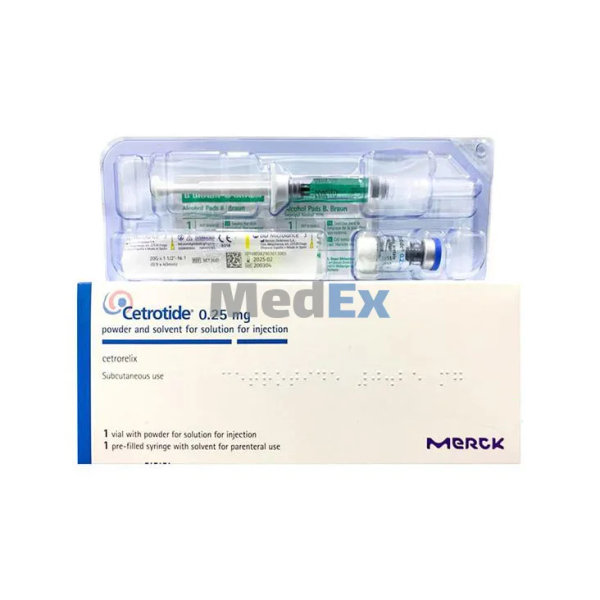
Cetrotide
 Generic: Cetrorelix Acetate
 Daily Dose:
 Course Duration:
 Alternatives (1)
Cheaper & Alternative Brands
Same generic (Cetrorelix Acetate), same form (SC Injection)
Clinical Prescribing Information
Medical monograph and safety information for healthcare professionals & patients.Indications & Clinical Uses
Cetrolix is indicated for the treatment of infertility in females. It restricts eggs to release directly and prevents premature ovulation. In Female infertility, Cetrolix prevents release of premature eggs during a process called ovulation in females. This helps in normal development
... Read more
Cetrolix is indicated for the treatment of infertility in females. It restricts eggs to release directly and prevents premature ovulation. In Female infertility, Cetrolix prevents release of premature eggs during a process called ovulation in females. This helps in normal development of an egg in a woman's ovary (female reproductive organ), and stimulates the release of a healthy, matured egg. This helps to treat infertility in women and increases the chance of a successful pregnancy.
Contraindications
Hypersensitivity to cetrorelix acetate, extrinsic peptide hormones or mannitol.
Pregnancy and lactation.
Postmenopausal women.
Patients with moderate and severe renal and hepatic impairment
Side Effects & Adverse Reactions
The most commonly reported adverse effects are local injection site reactions such as erythema, swelling and pruritus that are usually transient in nature and mild in intensity. Mild to moderate ovarian hyperstimulation syndrome (OHSS) (WHO grade I or II) have been commonly reported and should be considered as an intrinsic risk of the stimulation procedure.
Warnings & Precautions
This medicinal product must be allowed to reach room temperature prior to injection. It should be removed from the refrigerator approximately 30 minutes before use.
Do not use if the reconstituted solution contains particles or if the solution is not clear.
The solution should be used immediately after reconstitution.
Pharmacology & Mechanism of Action
Cetrorelix Acetate is a synthetic decapeptide with gonadotropin-releasing hormone (GnRH) antagonistic activity. Cetrorelix Acetate blocks the effects of GnRH. GnRH controls the secretion of luteinizing hormone (LH), which induces ovulation during the menstrual cycle. During hormone treatment for ovarian stimulation, premature ovulation may lead to eggs that are not suitable for fertilization. Cetrorelix Acetate blocks such undesirable premature ovulation. GnRH induces the production and release of luteinizing hormone (LH) and follicle stimulating hormone (FSH) from the gonadotropic cells of the anterior pituitary. Due to a positive estradiol (E2) feedback at midcycle, GnRH liberation is enhanced resulting in an LH-surge. This LH-surge induces the ovulation of the dominant follicle, resumption of oocyte meiosis and subsequently luteinization as indicated by rising progesterone levels.
Cetrorelix Acetate competes with natural GnRH for binding to membrane receptors on pituitary cells and thus controls the release of LH and FSH in a dose-dependent manner. The onset of LH suppression is approximately two hours with the 0.25 mg dose. This suppression is maintained by continuous treatment and there is a more pronounced effect on LH than on FSH. An initial release of endogenous gonadotropins has not been detected with Cetrorelix injection, which is consistent with an antagonist effect.
The effects of Cetrorelix Acetate on LH and FSH are reversible after discontinuation of treatment. In women, Cetrorelix Acetate delays the LH-surge, and consequently ovulation, in a dose dependent fashion. FSH levels are not affected at the doses used during controlled ovarian stimulation. A dose of Cetrorelix Acetate 0.25 mg every 24 hours has been shown to maintain the effect.