
Asidox
Cheaper & Alternative Brands
Same generic (Doxycycline Hydrochloride), same form (Capsule)

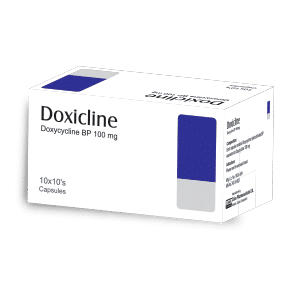
Clinical Prescribing Information
Medical monograph and safety information for healthcare professionals & patients.Indications & Clinical Uses
Apdox is indicated in the following infections caused by susceptible microorganisms:
Respiratory tract infections
: Pneumonia, influenza, sinusitis, bronchitis, tonsillitis, tracheitis.
Gastrointestinal tract infections
: Cholera, traveler's diarrhea, shigella dysentery, acute intestinal amebiasis.
... Read more
Apdox is indicated in the following infections caused by susceptible microorganisms:
Respiratory tract infections
: Pneumonia, influenza, sinusitis, bronchitis, tonsillitis, tracheitis.
Gastrointestinal tract infections
: Cholera, traveler's diarrhea, shigella dysentery, acute intestinal amebiasis.
Chlamydial infections
: Lympho-granuloma venereum, psittacosis, trachoma.
Sexually transmitted disease
s: Non gonococcal urethritis, acute pelvic inflammatory disease, uncomplicated urethral and endocervical or rectal infections, gonorrhoea, syphilis, pyelonephritis, cystitis.
Other infections
: Impetigo, furunculosis, inclusion conjunctivitis, brucellosis, tularemia, cellulitis, acne and Q-fever.
Contraindications
Doxycycline is contraindicated to the patients who have shown hypersensitivity to any of the tetracyclines. Doxycycline is contraindicated to the children under 8 years of age. It is also contraindicated to pregnant women and to the lactating mothers.
Side Effects & Adverse Reactions
Nausea, vomiting, diarrhoea, skin rashes, hemolytic anaemia, eosinophilia may be reported.
Warnings & Precautions
The use of drugs of the tetracycline class during tooth development (last half of pregnancy, infancy and childhood to the age of 8 years) may cause permanent discoloration of teeth. Tetracyclines drugs, therefore should not be used in this age group.
Pharmacology & Mechanism of Action
Doxycycline Hydrochloride is a semisynthetic tetracycline antibiotic with broad spectrum activity. It is primarily a bacteriostatic antibiotic. It has a similar spectrum of activity to other tetracyclines but in particular is more active against Staphylococcus aureus and Nocardia. The drug is often active against penicillin-resistant strains of Staphylococcus aureus and against strains of those organisms that are resistant to other Tetracyclines. Certain Gram-negative strains of E. coli, Proteus mirabilis and Klebsiella, which are often resistant to Tetracycline, may be sensitive to Doxycycline. In addition, 70-90% of the various anaerobes are sensitive to Doxycycline and Bacteroides fragilis is more likely to be sensitive to Doxycycline than to other tetracyclines.
Doxycycline is active against most strains of Haemophilus influenzaeand is particularly useful for infections with H. ducreyi, Actinomyces, Brucella and Vibrio cholerae. It is also active against Nocardia, Chlamydia, Mycoplasma and a wide range of Rickettsiae. Doxycycline is active against spirochetes such as Borellia recurrentis, Treponema pallidum and Treponema pertenue. It is also active against Plasmodium falciparum.