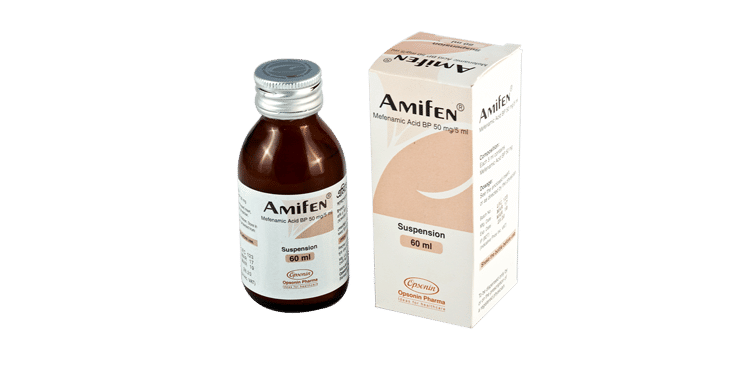
Amifen
Cheaper & Alternative Brands
Same generic (Mefenamic acid), same form (Oral Suspension)


Clinical Prescribing Information
Medical monograph and safety information for healthcare professionals & patients.Indications & Clinical Uses
Amifen is indicated for-
Fever
Toothache
Headache
Migraine
Primary dysmenorrhoea
Menorrhagia
Mild to moderate pain in rheumatoid arthritis and osteoarthritis
Traumatic pain
Low-back pain
Juvenile chronic arthritis in children etc.
Dosage & Administration
Adult
:
500 mg dose should be given to adults upto three times (1.5 gm total) per day with meals. The dosage may be reduced to 1 tablet (250 mg) three times daily.
In case of menorrhagia: 500 mg three times daily with meals and from the onset of menses and continued according to the judgement of the physician.
Children
:
6 months to 1 year: 5 ml three times/day.
2-4 years: 10 ml three times/day.
5-8 years: 10 ml four times /day.
9-12 years: 15 ml four times/day.
Treatment should not be continued for more than 7 days except on the advice of a physician.
Contraindications
It is contraindicated in patients with known hypersensitivity to Mefenamic Acid. It should not be used in patients with peptic ulcer, inflammatory bowel diseases, hepatic or renal impairment. It is also contraindicated in patients, whom aspirin and/or other NSAID's have induced symptoms of bronchospasm, skin rashes etc.
Side Effects & Adverse Reactions
The most frequently reported adverse experiences occurring in approximately 1-10% of patients are gastrointestinal: abdominal pain, constipation, diarrhoea, dyspepsia, flatulence, nausea, Gl ulcers, vomiting, dizziness, abnormal renal function, pruritus, rashes.
Warnings & Precautions
It should be administered with caution in allergic diseases especially in asthma. The treatment should be withdrawn in diarrhoea, rashes, cholestatic jaundice, thrombocytopenia, haemolytic anaemia.
Pharmacology & Mechanism of Action
Mefenamic acid contains Mefenamic Acid which is a nonsteroidal agent with demonstrated analgesic, anti-inflammatory and antipyretic activity due to its dual action on prostaglandins. It inhibits the enzymes of prostaglandin synthetase and also antagonizes the actions of prostaglandin at the receptor sites.