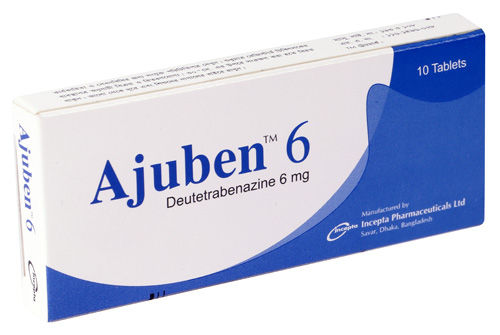
Ajuben
Cheaper & Alternative Brands
Same generic (Deutetrabenazine), same form (Tablet)Clinical Prescribing Information
Medical monograph and safety information for healthcare professionals & patients.Indications & Clinical Uses
Ajuben is a vesicular monoamine transporter 2 (VMAT2) inhibitor indicated for the treatment of-
Chorea associated with Huntington's disease
Tardive dyskinesia in adults.
Dosage & Administration
Patients not presently receiving Tetrabenazine:
Chorea associated with Huntington’s disease
-
Initial dose: 6 mg/day
Maintenance dose: 6 mg-48 mg/day
Maximum dose: 48 mg/day
Tardive dyskinesia
-
Initial dose: 12 mg/day
Maintenance dose: 12 mg-48 mg/day
Maximum dose: 48 mg/day
Titrate up at weekly intervals by 6 mg per day to a tolerated dose that reduces chorea, up to a maximum recommended daily dosage of 48 mg (24 mg twice daily). Administer total daily dosages of 12 mg or above in two divided doses and administer with foods.
Patients receiving Tetrabenazine
: If switching patients from tetrabenazine, discontinue tetrabenazine and initiate deutetrabenazine the following day. The recommended initial dosing regimen of deutetrabenazine in patients switching from tetrabenazine to deutetrabenazine is shown in below chert:
Current Tetrabenazine daily dosage
Initial regimen of Deutetrabenazine
12.5 mg
6 mg once daily
25 mg
6 mg once daily
37.5 mg
9 mg once daily
50 mg
12 mg once daily
62.5 mg
15 mg once daily
75 mg
18 mg once daily
87.5 mg
21 mg once daily
100 mg
24 mg once daily
After patients are switched to deutetrabenazine, the dose may be adjusted at weekly intervals.
Contraindications
Deutetrabenazine is contraindicated in patients with Suicidal, or untreated/inadequately treated depression, Hepatic impairment and in patients Taking MAOIs, reserpine, or tetrabenazine.
Side Effects & Adverse Reactions
Most common adverse reactions (>8%) of deutetrabenzine’s are somnolence, diarrhea, dry mouth, and fatigue.
Warnings & Precautions
Patients may experience Neuroleptic Malignant Syndrome (discontinue Ajuben if this occurs), Akathisia, agitation, restlessness, and Parkinsonism (reduce the daily dose of Ajuben or discontinue if this occurs) and Sedation/somnolence.
Pharmacology & Mechanism of Action
The precise mechanism by which deutetrabenazine exerts its anti-chorea effects is unknown but is believed to be related to its effect as a reversible depletor of monoamines (such as dopamine, serotonin, norepinephrine, and histamine) from nerve terminals. The major circulating metabolites (α-dihydrotetrabenazine and β-dihydrotetrabenazine) of deutetrabenazine, are reversible inhibitors of vesicular monoamine transporter 2 (VMAT2), resulting in decreased uptake of monoamines into synaptic vesicles and depletion of monoamine stores.