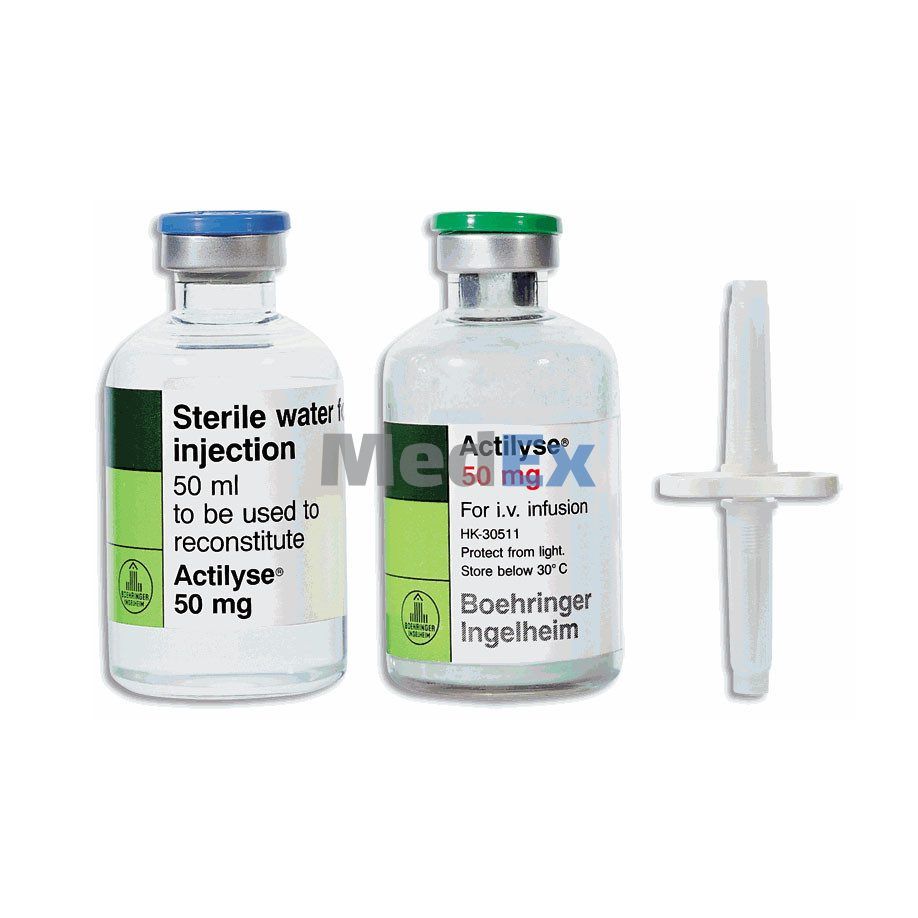
Actilyse
Cheaper & Alternative Brands
Same generic (Alteplase), same form (IV Infusion)No other brands currently registered with this exact active generic and dosage form.
Clinical Prescribing Information
Medical monograph and safety information for healthcare professionals & patients.Indications & Clinical Uses
Acute Ischemic Stroke
: Actilyse is indicated for the treatment of acute ischemic stroke. Exclude intracranial hemorrhage as the primary cause of stroke signs and symptoms prior to initiation of treatment. Initiate treatment as soon as possible but within 3 hours after symptom onset
... Read more
Acute Ischemic Stroke
: Actilyse is indicated for the treatment of acute ischemic stroke. Exclude intracranial hemorrhage as the primary cause of stroke signs and symptoms prior to initiation of treatment. Initiate treatment as soon as possible but within 3 hours after symptom onset.
Acute Myocardial Infarction
: Actilyse is indicated for use in acute myocardial infarction (AMI) for the reduction of mortality and the reduction of the incidence of heart failure.
Pulmonary Embolism
: Actilyse is indicated for the lysis of acute massive pulmonary embolism, defined as:
Acute pulmonary emboli obstructing blood flow to a lobe or multiple lung segments.
Acute pulmonary emboli accompanied by unstable hemodynamics, e.g., failure to maintain blood pressure without supportive measures.
Contraindications
Acute Ischemic Stroke
: Do not administer Alteplase to treat acute ischemic stroke in the following situations in which the risk of bleeding is greater than the potential benefit [see Warnings and Precautions (5.1)]:
Current intracranial hemorrhage
Subarachnoid hemorrhage
Active internal bleeding
Recent (within 3 months) intracranial or intraspinal surgery or serious head trauma
Presence of intracranial conditions that may increase the risk of bleeding (e.g., some neoplasms, arteriovenous malformations, or aneurysms)
Bleeding diathesis
Current severe uncontrolled hypertension.
Acute Myocardial Infarction or Pulmonary Embolism
: Do not administer Alteplase for treatment of AMI or PE in the following situations in which the risk of bleeding is greater than the potential benefit:
Active internal bleeding
History of recent stroke
Recent (within 3 months) intracranial or intraspinal surgery or serious head trauma
Presence of intracranial conditions that may increase the risk of bleeding (e.g. some neoplasms, arteriovenous malformations, or aneurysms)
Bleeding diathesis
Current severe uncontrolled hypertension.
Side Effects & Adverse Reactions
The following adverse reactions are:
Bleeding
Orolingual Angioedema
Cholesterol Embolization
Reembolization of Deep Venous Thrombi during Treatment for Acute Massive Pulmonary
Embolism.
Warnings & Precautions
Increases the risk of bleeding. Avoid intramuscular injections. Monitor for bleeding. If serious bleeding occurs, discontinue Actilyse.
Monitor patients during and for several hours after infusion for orolingual angioedema. If angioedema develops, discontinue Actilyse.
Cholesterol embolism has been reported rarely in patients treated with thrombolytic agents.
Consider the risk of reembolization from the lysis of underlying deep venous thrombi in patients with pulmonary embolism.
Pharmacology & Mechanism of Action
Alteplase is a serine protease responsible for fibrin-enhanced conversion of plasminogen to plasmin. It produces limited conversion of plasminogen in the absence of fibrin. When introduced into the systemic circulation at pharmacologic concentration, alteplase binds to fibrin in a thrombus and converts the entrapped plasminogen to plasmin. This initiates local fibrinolysis with limited systemic proteolysis.
Pharmacodynamics
: Following administration of 100 mg Alteplase, there is a decrease (16%-36%) in circulating fibrinogen. In a controlled trial, 8 of 73 patients (11%) receiving Alteplase (1.25 mg/kg body weight over 3 hours) experienced a decrease in fibrinogen to below 100 mg/dL.
Pharmacokinetics
: Alteplase in acute myocardial infarction (AMI) patients is rapidly cleared from the plasma with an initial half-life of less than 5 minutes. There is no difference in the dominant initial plasma half-life between the 3-hour and accelerated regimens for AMI. The plasma clearance of alteplase is 380-570 mL/min, primarily mediated by the liver. The initial volume of distribution approximates plasma volume.