Selexipag
💊 Brand Formulations & Prices
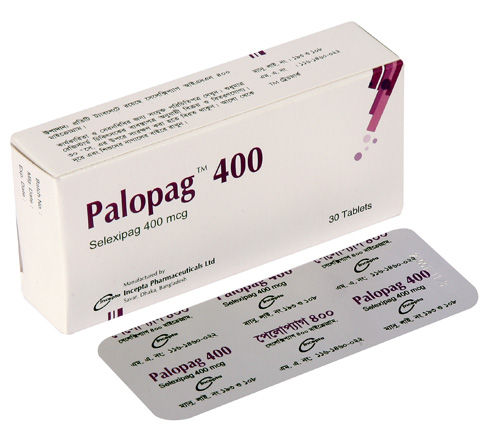
2 brands sorted by unit price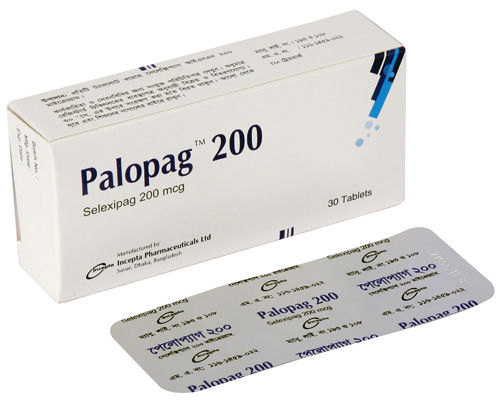
📖 Official Clinical Monograph
DGDA Approved Prescribing GuidelinesPalopag tablet is indicated for the treatment of pulmonary arterial hypertension (PAH, WHO Group I) to delay disease progression and reduce the risk of hospitalization for PAH.
The recommended starting dose is 200 mcg twice daily. Tolerability may be improved when taken with food. Increase the dose by 200 mcg twice daily at weekly intervals to the highest tolerated dose up to 1600 mcg twice daily. The maintenance dose is determined by tolerability.
The most common side-effects of Palopag are Nausea, Diarrhoea, Vomiting, Headache, Jaw pain, muscle pain, low appetite and low RBC count.
Discontinue Palopag if the patient develops the sign and symptoms of Pulmonary Veno-Occlusive Disease (PVOD)
Selexipag is a selective non-prostanoid IP prostacyclin receptor agonist. Selexipag is a pale yellow crystalline powder that is practically insoluble in water. In the solid-state selexipag is very stable, is not hygroscopic, and is not light sensitive. Selexipag is an oral prostacyclin receptor (IP receptor) agonist that is structurally distinct from prostacyclin. Selexipag is hydrolyzed by carboxylesterase 1 to yield its active metabolite, which is approximately 37-fold as potent as selexipag. Selexipag and the active metabolite are selective for the IP receptor versus other prostanoid receptors (EP1-4, DP, FP, and TP).