Oteseconazole
💊 Brand Formulations & Prices
6 brands sorted by unit price
Otegal

Otecon
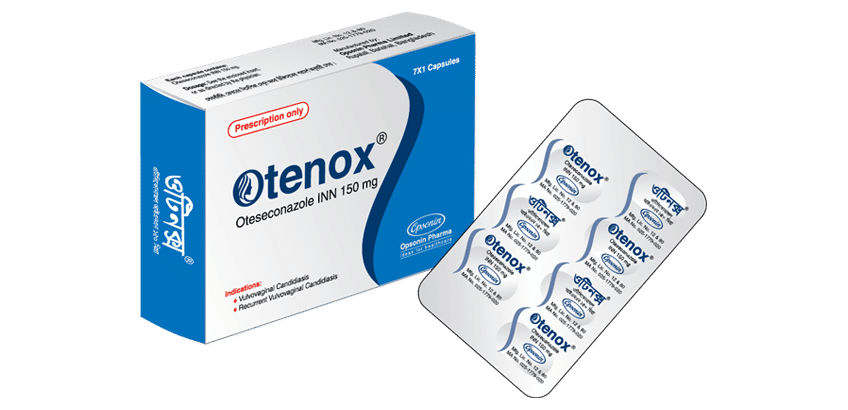
Otenox

Otes

Otezol

Vulcan
📖 Official Clinical Monograph
DGDA Approved Prescribing GuidelinesOtecon is indicated to reduce the incidence of recurrent vulvovaginal candidiasis (RVVC) in females with a history of RVVC who are not of reproductive potential. If specimens for fungal culture are obtained prior to therapy, antifungal therapy may be instituted before the results of the cultures are known. However, once these results become available, antifungal therapy should be adjusted accordingly.
There are two recommended Oteseconazole dosage regimens:
For the Oteseconazole-only dosage regimen:
On Day 1
: Administer Oteseconazole 600 mg (as a single dose), then
On Day 2
: Administer Oteseconazole 450 mg (as a single dose), then
Beginning on Day 14
: Administer Oteseconazole 150 mg once a week (every 7 days) for 11 weeks (Weeks 2 through 12).
For the Fluconazole/Oteseconazole dosage regimen, prescribe Fluconazole and:
On Day 1, Day 4, and Day 7
: Administer fluconazole 150 mg orally, then
On Days 14 through 20
: Administer Oteseconazole 150 mg once daily for 7 days, then
Beginning on Day 28
: Administer Oteseconazole 150 mg once a week (every 7 days) for 11 weeks (Weeks 4 through 14).
Administer Oteseconazole orally with food. Swallow the capsules whole. Do not chew, crush, dissolve, or open the capsules.
Oteseconazole is contraindicated in:
Females of reproductive potential
Pregnant and lactating women
Patients with known hypersensitivity to oteseconazole
The most frequently reported adverse reactions (incidence >2%) were headache and nausea.
Embryo-Fetal Toxicity
: Otecon is contraindicated in females of reproductive potential, and in pregnant and lactating women. Based on animal studies, Otecon may cause fetal harm. The drug exposure window of approximately 690 days (based on 5 times the half-life of Otecon) precludes adequate mitigation of the embryo-fetal toxicity risks. Ocular abnormalities were observed in the offspring of pregnant rats dosed at 7.5-mg/kg/day during organogenesis through lactation in pre and postnatal developmental studies. The observed ocular abnormalities included cataracts, opacities, exophthalmos/buphthalmos, optic nerve/retinal atrophy, lens degeneration and hemorrhage. Ocular abnormalities occurred at doses about 3.5 times the steady state clinical exposure seen with patients being treated for RVVC. Advise patients that Otecon is contraindicated in females of reproductive potential, and in pregnant and lactating women because of potential risks to a fetus or breastfed infan.
Oteseconazole is an antifungal drug. Oteseconazole exposure-response relationships and the time course of pharmacodynamic response are unknown. Oteseconazole is an azole metalloenzyme inhibitor targeting the fungal sterol, 14α demethylase (CYP51), an enzyme that catalyzes an early step in the biosynthetic pathway of ergosterol, a sterol required for fungal cell membrane formation and integrity. Inhibition of CYP51 results in the accumulation of 14-methylated sterols, some of which are toxic to fungi. Through the inclusion of a tetrazole metal-binding group, oteseconazole has a lower affinity for human CYP enzymes.