Fluticasone Propionate + Formoterol Fumarate
💊 Brand Formulations & Prices
5 brands sorted by unit price
Flomyst F
Flomyst F
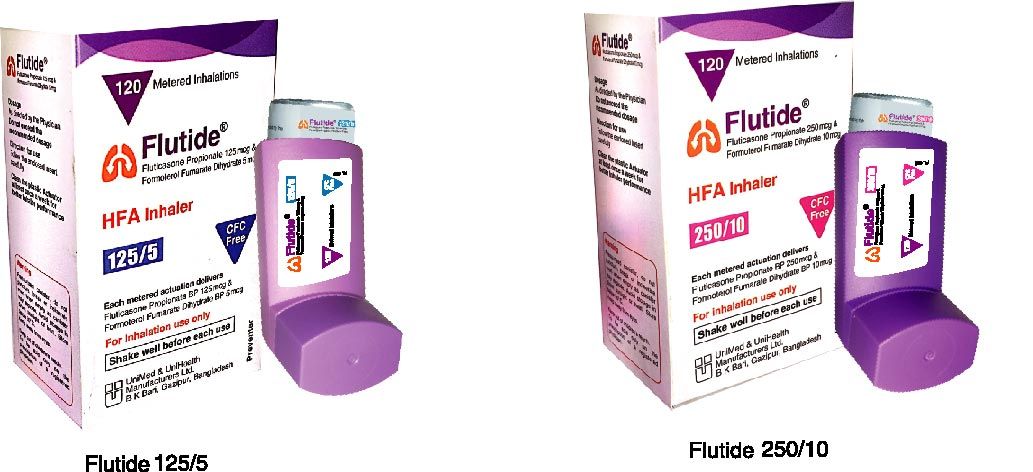
Flutide
Flomyst F
Flutide
📖 Official Clinical Monograph
DGDA Approved Prescribing GuidelinesAsthma
: Flomyst F is a fixed-dose combination of Fluticasone Propionate and Formoterol Fumarate is indicated in the regular treatment of asthma where the use of a combination product (an inhaled corticosteroid and a long-acting ß2 agonist) is appropriate:
For patients not adequately controlled with inhaled corticosteroids and "as required" inhaled short-acting ß2 agonist. Or,
... Read more
Asthma
: Flomyst F is a fixed-dose combination of Fluticasone Propionate and Formoterol Fumarate is indicated in the regular treatment of asthma where the use of a combination product (an inhaled corticosteroid and a long-acting ß2 agonist) is appropriate:
For patients not adequately controlled with inhaled corticosteroids and "as required" inhaled short-acting ß2 agonist. Or,
For patients already adequately controlled on both an inhaled corticosteroid and a long-acting ß2 agonist.
Fluticasone Propionate 125 mcg and Formoterol Fumarate 5 mcg inhaler are indicated in adults and adolescents aged 12 years and above.
COPD
: Flomyst F is recommended when a long-acting ß2 agonist/Inhaled corticosteroid is indicated & patients are unable to use other long-acting ß2 agonist/Inhaled corticosteroid.
Fluticasone Propionate 125 mcg and Formoterol Fumarate 5 mcg inhaler is indicated in adults only.
this inhaler should not be used to treat acute asthma symptoms for which a fast and short-acting bronchodilator is required. Patients should be advised to have their medicine to be used for relief in an acute asthma attack available at all times.
The prophylactic use of this inhaler in exercise-induced asthma has not been studied. For such use, a separate rapid-acting bronchodilator should be considered. Patients should be reminded to take their this inhaler maintenance dose as prescribed, even when asymptomatic. Patients should not be initiated on this inhaler during an exacerbation, or if they have significantly worsening or acutely deteriorating asthma. Serious asthma-related adverse events and exacerbations may occur during treatment with this inhaler. Patients should be asked to continue treatment but to seek medical advice if asthma symptoms remain uncontrolled or worsen after initiation on this inhaler.
This inhaler should not be used as the first treatment for asthma.
This inhaler should be administered with caution in patients with pulmonary tuberculosis, quiescent tuberculosis or patients with fungal, viral or other infections of the airway. This inhaler should be used with caution in patients with thyrotoxicosis, phaeochromocytoma, diabetes mellitus, uncorrected hypokalaemia or patients predisposed to low levels of serum potassium, hypertrophic obstructive cardiomyopathy, idiopathic subvalvular aortic stenosis, severe hypertension, aneurysm or other severe cardiovascular disorders, such as ischaemic heart disease, cardiac arrhythmias or severe heart failure. Caution must be observed when treating patients with existing prolongation of the QTc interval. Formoterol itself may induce prolongation of the QTc interval.
As for all ß2 agonists, additional blood sugar controls should be considered in diabetic patients. As with other inhalation therapy paradoxical bronchospasm may occur with an immediate increase in wheezing and shortness of breath after dosing. This inhaler should be discontinued immediately, the patient assessed and alternative therapy instituted if necessary.
Systemic effects may occur with any inhaled corticosteroid, particularly at high doses prescribed for long periods. These effects are much less likely to occur than with oral corticosteroids. Possible systemic effects include Cushing’s syndrome, Cushingoid features, adrenal suppression, growth retardation in children and adolescents, decrease in bone mineral density, cataract glaucoma and more rarely, a range of psychological or behavioural effects including psychomotor hyperactivity, sleep disorders, anxiety, depression or aggression (particularly in children). It is important, therefore, that the patient is reviewed regularly and the dose of inhaled corticosteroid is reduced to the lowest dose at which effective control of asthma is maintained.
As with other inhalation therapy, paradoxical bronchospasm may occur with an immediate increase in wheezing and shortness of breath after dosing. Since Flutide inhaler contains both Fluticasone Propionate and FormoterolFumarate, the same pattern of undesirable effects as reported for these substances may occur. In the unlikely event of a hypersensitivity reaction to Flutide inhaler, treatment should be initiated in accordance with standard treatment for any other hypersensitivity reaction, which may include the use of antihistamines and other treatment as required. Flutide inhaler may need to be discontinued immediately and an alternative asthma therapy may need to be initiated if necessary. Dysphonia and candidiasis may be relieved by gargling or rinsing the mouth with water or brushing the teeth after using the product. Symptomatic candidiasis can be treated with topical anti-fungal therapy whilst continuing the treatment with Flutide inhaler.
This inhaler (a pressurised inhalation, suspension) which contains two active ingredients:
Fluticasone propionate which belongs to a group of medicines called steroids. Steroids help to reduce swelling and inflammation in the lungs.
Formoterol fumarate dihydrate which belongs to a group of medicines called long-acting beta 2 agonists. Long-acting beta 2 agonists are long-acting bronchodilators which help the airways in your lungs to stay open, making it easier for you to breathe.
Together these two active ingredients help to improve your breathing. It is advised that you should use this medicine every day as directed by your doctor or asthma nurse.
This medicine helps to prevent breathing problems such as asthma and helps to stop you becoming breathless and wheezy. However, it does not work if you are already having an asthma attack i.e. you are already breathless and wheezing. You will need to use a fast acting ‘reliever’ medicine such as salbutamol if this happens.