Apalutamide
💊 Brand Formulations & Prices
2 brands sorted by unit price
📖 Official Clinical Monograph
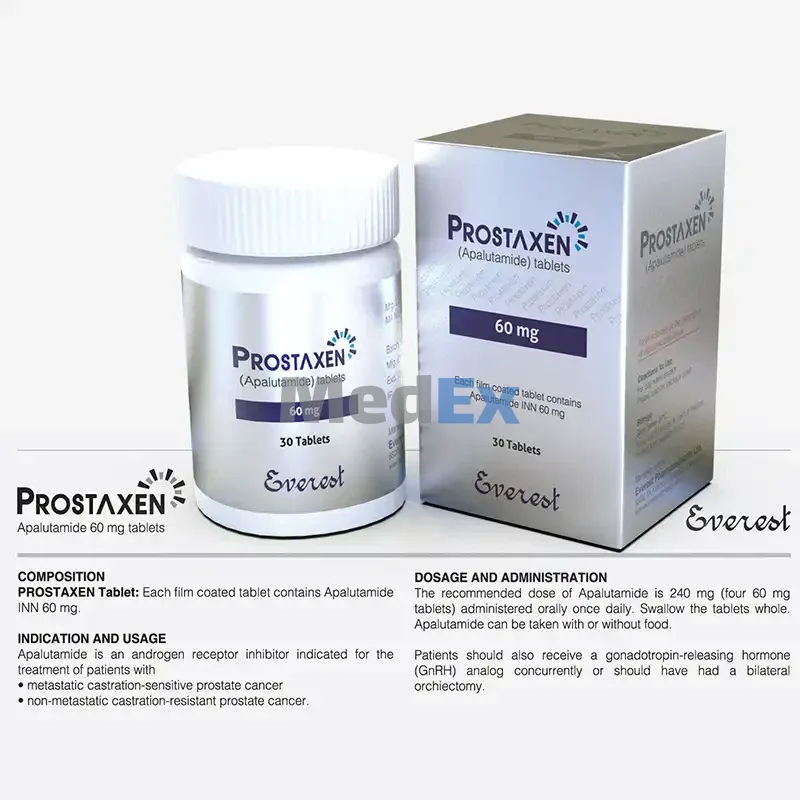
DGDA Approved Prescribing GuidelinesApaluda is an androgen receptor inhibitor indicated for the treatment of patients with-
metastatic castration-sensitive prostate cancer
non-metastatic castration-resistant prostate cancer.
The recommended dose of Apalutamide is 240 mg (four 60 mg tablets) administered orally once daily. Swallow the tablets whole. Apalutamide can be taken with or without food. Patients should also receive a gonadotropin-releasing hormone (GnRH) analog concurrently or should have had a bilateral orchiectomy.
Hypersensitivity to the active substance
Women who are or may become pregnant
The following clinically significant adverse reactions are observed in clinical trial:
Endocrine disorders: Hypothyroidism
Metabolism and nutrition disorders: hypercholesterolaemia, hypertriglyceridaemia
Nervous system disorders: Dysgeusia, seizure
Cardiac disorders: ischaemic heart disease
Vascular disorders: hot flush, hypertension
Gastrointestinal disorders: diarrhea
Skin and subcutaneous tissue disorders: skin rash, pruritus
Musculoskeletal and connective tissue disorders: fracture, arthralgia, muscle spasm
General disorders and administration site conditions: fatigue
Investigations: weight decreased
Injury, poisoning and procedural complications: fall, fracture
Seizure
: Apaluda is not recommended in patients with a history of seizures or other predisposing factors including, but not limited to, underlying brain injury, recent stroke (within one year), primary brain tumours or brain metastases. If a seizure develops during treatment with Apaluda, treatment should be discontinued permanently. In two randomised studies (SPARTAN and TITAN), seizure occurred in 0.4% of patients receiving Apaluda and in 0.2% of patients treated with placebo. These studies excluded patients with a history of seizure or predisposing factors for seizure.
Falls and fractures
: Falls and fractures occurred in patients receiving Apaluda. Patients should be evaluated for fracture and fall risk before starting Apaluda and should continue to be monitored and managed according to established treatment guidelines and use of bone-targeted agents should be considered.
Ischaemic heart disease
: Ischaemic heart disease, including events leading to death, occurred in patients treated with Apaluda. The majority of patients had cardiac risk factors. Patients should be monitored for signs and symptoms of ischaemic heart disease and management of cardiovascular risk factors, such as hypertension, diabetes, or dyslipidaemia should be optimised as per standard of care.
Concomitant use with other medicinal products
: Apaluda is a potent enzyme inducer and may lead to loss of efficacy of many commonly used medicinal products. Concomitant use of Apaluda with medicinal products that are sensitive substrates of many metabolising enzymes or transporters should generally be avoided if their therapeutic effect is of large importance to the patient, and if dose adjustments cannot easily be performed based on monitoring of efficacy or plasma concentrations. Co administration of Apaluda with warfarin and coumarin-Iike anticoagulants should be avoided. If Apaluda is co-administered with an anticoagulant metabolised by CYP2C9 (such as warfarin or acenocoumarol), additional International Normalised Ratio (INR) monitoring should be conducted.
Recent cardiovascular disease
: Patients with clinically significant cardiovascular disease in the past 6 months including severe/unstabie angina, myocardial infarction, symptomatic congestive heart failure, arterial or venous thromboembolic events (e.g., pulmonary embolism, cerebrovascular accident including transient ischaemic attacks), or clinically significant ventricular arrhythmias were excluded from the clinical studies. Therefore, the safety of Apaluda in these patients has not been established. If Apaluda is prescribed, patients with clinically significant cardiovascular disease should be monitored for risk factors such as hypercholesterolaemia, hypertriglyceridaemia, or other cardio-metabolic disorders. Patients should be treated after initiating Apaluda for these conditions according to established treatment guidelines.
Androgen deprivation therapy may prolong the QT interval
: In patients with a history of or risk factors for QT prolongation and in patients receiving concomitant medicinal products that might prolong the QT interval, physicians should assess the benefit-risk ratio including the potential for Torsade de pointes prior to initiating Apaluda.
Apalutamide is an orally administered, selective Androgen Receptor (AR) inhibitor that binds directly to the ligand-binding domain of the AR. Apalutamide prevents AR nuclear translocation, inhibits DNA binding, impedes AR-mediated transcription, and lacks androgen receptor agonist activity. Apalutamide treatment decreases tumor cell proliferation and increases apoptosis leading to potent antitumor activity.